
Storm Damage? We Respond 24/7 — Call (267) 245-5320 Now
Dublin, PA — Bucks County & Lehigh Valley
Family Owned Since 2016
Available 24/7
📞 (267) 245-5320
Safety Guide — Bucks County, PA

Tree Removal Near Power Lines in Bucks County, PA: What Your Electric Utility Handles (and What They Don't)

Oscars Tree Removal & Stone Veneer · Bucks County, PA · Updated May 2026 · 10–12 min read
The Short Answer

PECO — the electric utility serving all of Bucks County — handles trimming and removal that directly threatens their lines, at no cost to you. Everything else is yours: dead trees, leaning trees, structurally compromised trees, and any debris left behind after PECO's crew finishes. If you're looking at a tree near a line and wondering who's responsible, the question isn't really about the power line. It's about who owns the problem with the tree.

Who Is Responsible for Trees Near Power Lines in Bucks County?

Most Bucks County homeowners assume that if a tree is near a power line, PECO is on the hook for it. That's not how it works — and the misunderstanding leads to two bad outcomes: homeowners who do nothing while a dangerous tree deteriorates, and homeowners who call PECO expecting full removal and get a trim crew that addresses only the branch touching the wire.

PECO serves southeastern Pennsylvania including all of Bucks County — communities like Warminster, Doylestown, Perkasie, Quakertown, Yardley, and everything in between. They are responsible for maintaining the reliability of their infrastructure. You are responsible for the trees on your property. Those are two separate things, even when they're physically adjacent.

Trees account for approximately 40% of all power outages across PECO's service area. That's exactly why they spend heavily on vegetation management — $75 million committed in 2025 alone. But that program exists to protect their equipment, not to provide free tree removal service to property owners.

The PECO vs. Homeowner Responsibility Split

Here's how the responsibility actually breaks down. This isn't legal advice — it's a practical guide to how PECO operates and how the liability typically lands in Pennsylvania.

Situation Who Handles It What That Means
Branch actively touching or growing into a distribution line PECO PECO will trim or remove vegetation in direct contact with their lines, at no cost to the property owner. They follow ANSI A300 pruning standards.
Tree in your yard that's growing toward but not yet touching a line Homeowner You can request PECO evaluate it, but they may not act until the line is at risk. A proactive private contractor can prune it back on your schedule before it becomes an emergency.
Dead or dying tree that happens to be near a power line Homeowner PECO does not remove dead trees as a property service. If the tree is structurally compromised and near a line, you need to hire a licensed tree service — the closer to the line, the more specialized the job.
Tree that has fallen on a power line PECO + Homeowner PECO secures the line and repairs their equipment. You hire a contractor to remove the tree from your property once the line is safe. Two separate jobs, two separate parties.
Debris left after PECO's crew trims around their lines Homeowner PECO will cut what they need to cut. Cleanup of the branches, logs, and chips left on your property is your responsibility. They are not a full-service tree company.
Trimming you want done near a line for aesthetics or light Homeowner PECO does not trim for aesthetic reasons. If you want work done near a line on your timeline, hire a contractor certified for line-clearance work. Never attempt this yourself.

What PECO's Tree Trimming Program Covers (and What It Doesn't)

PECO's vegetation management program is real and it's significant. In 2025 they're investing $75 million in tree and vegetation clearance across southeastern Pennsylvania. In areas where they've completed this work, vegetation-related outages have dropped by 30%. That's a meaningful program — but it's worth understanding what it actually involves.

PECO uses two types of vegetation management:

  • Preventive pruning: Fast-growing limbs and branches are cut back away from lines on a regular cycle. PECO certified arborists follow directional pruning techniques designed to train growth away from the line over time.
  • Tree removal: When a tree poses a serious threat to the line and pruning isn't a viable long-term solution, PECO will remove the tree. This is not routine — it's reserved for trees where the line clearance risk cannot otherwise be managed.

All of PECO's work is done by certified arborists trained to ANSI A300 Part 1 standards. That's the same standard professional tree services use. The difference: PECO's crew is there to serve the line, not the tree. Their pruning approach prioritizes clearance, which can sometimes create lopsided, structurally weakened trees over time — because a healthy canopy shape isn't their priority. A well-rounded crown is yours.

How to Request PECO Service

For non-emergency concerns — a branch growing toward a line, a tree you think poses a risk — call PECO at 1-800-494-4000 or submit a request through their website. For emergencies where a tree or branch has contacted a live line, call 1-800-841-4141 immediately. Response times for non-emergency requests can range from weeks to months depending on their current schedule in your area.

Can PECO Trim Your Trees Without Asking? (The Right-of-Way Question)

This surprises a lot of Bucks County homeowners: yes, PECO can trim — or remove — trees on your private property without requesting your permission first. They have a legal right-of-way easement that gives them authority to clear vegetation within a defined corridor around their distribution lines, regardless of property lines.

This right-of-way is established in PECO's franchise agreement with the Commonwealth of Pennsylvania and is standard for all regulated electric utilities in the state. If PECO determines a tree on your property is an immediate threat to their infrastructure, they will act. They are required to follow ANSI A300 pruning standards and use certified arborists, but their objective is line clearance — not your tree's long-term structural health or appearance.

What this means practically:

  • PECO may show up and trim a tree on your property without advance notice in emergency situations
  • For non-emergency trimming cycles, they typically notify affected neighborhoods in advance, though not always individual homeowners
  • The pruning may leave your tree looking lopsided or unbalanced — because one side was cleared for the line and the other was left untouched
  • If their work structurally weakens your tree, the resulting hazard becomes your problem to manage
  • Debris from their trimming is left on your property

If PECO has already trimmed a tree on your property and you're concerned about its structure or stability afterward, a professional assessment is worth having. An unbalanced tree that's been directionally pruned toward a line is a legitimate hazard in high-wind events.

When You Need to Hire a Private Contractor (Not PECO)

There's a wide category of power-line tree situations that are entirely your problem to solve, and where you shouldn't wait on PECO. These are also situations where hiring just any tree company won't do — work within proximity to energized distribution lines requires specific training, equipment, and insurance.

Dead or Structurally Failed Trees Near Lines

If a tree on your property is dead, has major structural defects, or shows signs of failure — and it's positioned to hit a line if it falls — that's an urgent private contractor situation. PECO will not proactively remove a dead tree from your property. Identifying a dead or dying tree early and getting it down before it falls is far less expensive than dealing with an emergency situation after it's already on the wire.

Preventive Pruning on Your Schedule

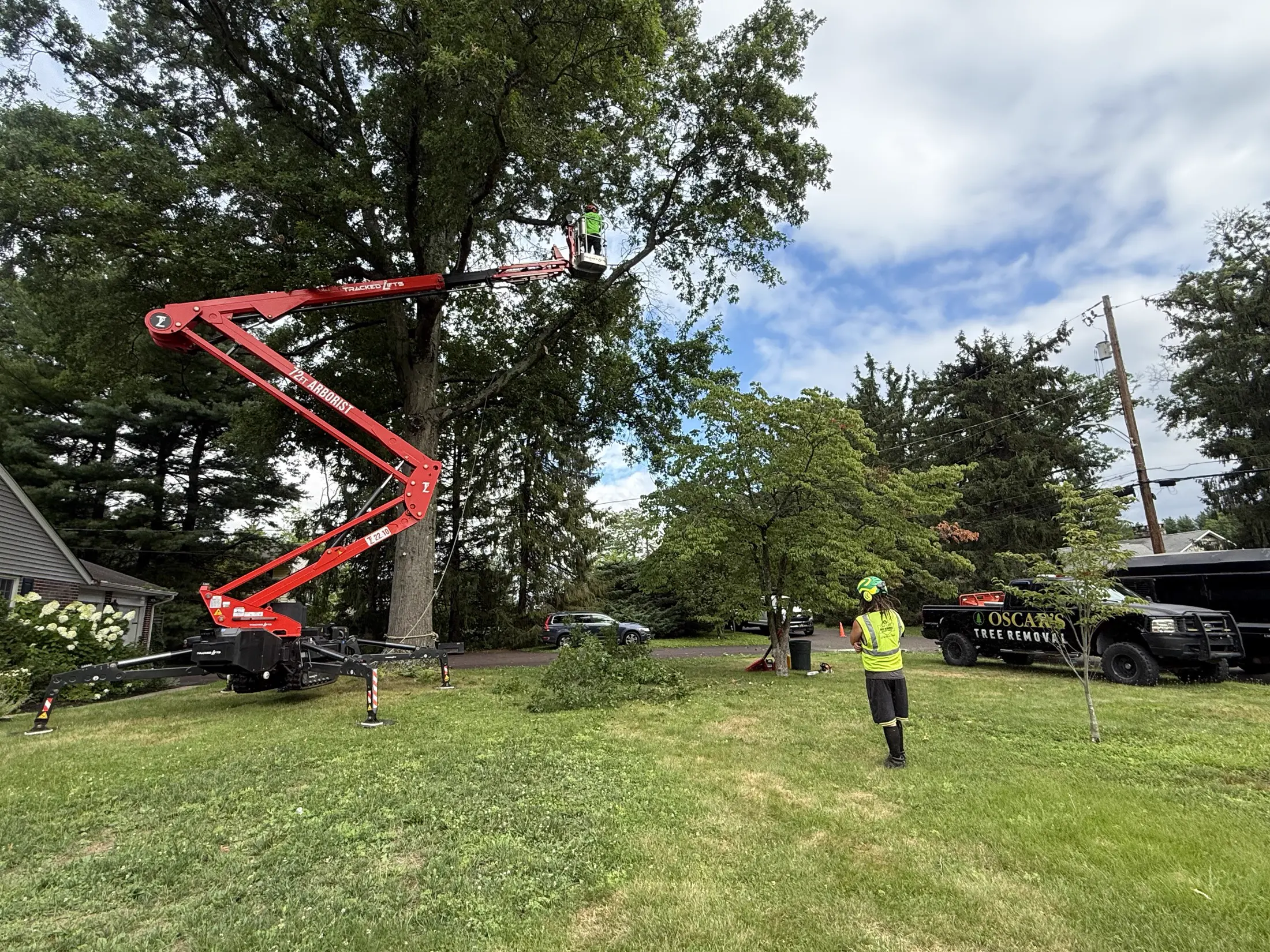
If you have a large tree that's growing toward a line and you want it addressed before it becomes PECO's problem, a private contractor can handle the pruning. This is often a smarter move than waiting: you get the work done correctly and completely, not just cleared from the wire. Our tree trimming service includes work near utility lines by trained crew members who know how to work in proximity to infrastructure.

Who Cleans Up After PECO Trims Your Trees?

PECO's tree crews are not cleanup crews. After they've pruned around a line, the debris — branches, limbs, brush — stays on your property. Some homeowners are surprised by the volume of material left behind, especially after major preventive pruning cycles. A tree service can haul it all out in a single visit.

Emergency Tree Service After a Storm

After major storms, the sequence matters. PECO responds to restore power — that means securing downed lines and removing whatever is actively interfering with their equipment. Once they've cleared and secured the line, your contractor comes in to remove the tree from your property. Our 24/7 emergency tree service responds throughout Bucks County when lines come down and trees need to come out fast.

Never DIY Near a Power Line

Distribution lines running through Bucks County neighborhoods are not insulated. They look like cable or phone lines, but contact with them is fatal. Pennsylvania OSHA regulations require that only qualified line clearance arborists work within 10 feet of energized lines. This is not a job for a chainsaw and a ladder. If the tree is anywhere near a line, hire a licensed contractor.
Warning Signs a Power-Line Tree Can't Wait

These signs mean a tree near your utility line needs professional attention now — not after the next storm. If you see any of these, call for an estimate before it becomes an emergency.

Dead or Leafless Crown

A tree that fails to leaf out in spring, or has an entirely dead crown, has lost its structural integrity. Dead wood is brittle and unpredictable — it doesn't bend in wind, it breaks. A dead tree adjacent to a power line is a liability with a timer on it. Don't rely on PECO to deal with it. Learn how to tell if a tree is dead.

Visible Lean Toward the Line

A tree that's visibly leaning toward a power line — especially one that wasn't leaning before — is showing root failure or structural compromise. The lean will only worsen. A saturated soil event or wind event can bring it down fast. This is urgent.

Cracks or Splits in Major Limbs

Large included bark pockets, co-dominant stems with visible cracks, or limbs that have already partially split are high failure risk. Any one of these that's overhanging a line could drop without warning. A certified arborist can assess whether removal or targeted pruning is the right call.

EAB Damage (Ash Trees)

The Emerald Ash Borer has killed tens of thousands of ash trees across Bucks County. Dead ash trees become extremely brittle very quickly — faster than most other species. An ash tree near a power line that shows EAB signs (S-shaped galleries under bark, D-shaped exit holes, crown dieback) needs to come down. EAB ash removal costs more than a live tree of the same size due to the specialized rigging required.

Fungal Growth at the Base

Mushrooms, shelf fungus, or conks growing at the base of a tree or on the trunk are signs of internal decay. A tree can look healthy from the outside while being structurally hollow inside. If you see fungal growth on a tree near a power line, get it assessed immediately — not next season.

Crown Already in the Wire

If branches are already resting on or tangled in the line, the tree is past the "let PECO know" stage. Call PECO for the line clearance portion and have a contractor ready to handle the tree itself. A branch resting on a live line is an active hazard for anyone near it.

Why Tree Removal Near Power Lines Costs More

Power-line proximity adds meaningful cost to any tree removal job. Here's what drives the premium and what to expect when you're getting a quote. For full baseline pricing, see our Bucks County tree removal cost guide.

Cost Factor Why It Adds Cost Typical Impact
Aerial lift required Trees entangled with lines can't be climbed safely. An aerial lift allows the crew to work from a controlled position without contact risk. +$300–$800 depending on size
Line clearance coordination Some jobs require notifying PECO before work begins, or having a line-clearance qualified crew on site. This adds scheduling and labor. +$200–$500
Piece-by-piece removal Trees near lines can't simply be felled. Every piece must be rigged, lowered, and placed — which takes significantly more time than a standard drop. 25–50% above base cost
EAB ash or dead wood Brittle wood makes climbing impossible. Aerial lift and specialized rigging are required for most dead or EAB-affected trees near lines. +20–40% above comparable live tree
After-storm emergency timing Post-storm demand, after-hours mobilization, and working in compromised conditions all add to the rate for emergency situations. 25–75% emergency premium

The only accurate number is a written estimate after a trained eye looks at your specific tree. If a company gives you a firm phone quote on a power-line job without seeing it, that's a red flag.

What to Do If a Tree or Branch Hits a Power Line

This is the scenario most people aren't prepared for. Whether it's a sudden storm-caused failure or a slow lean that finally gave way, here's the sequence to follow.

  1. 1
    Keep everyone away from the tree and the area around it. A downed or contacted power line can energize the ground within 35 feet in any direction. Don't approach the tree. Don't let anyone else approach it. If you're inside, stay inside. If you're outside, don't run — shuffle away with your feet together to avoid creating a current path through your body.
  2. 2
    Call PECO immediately at 1-800-841-4141. This is their 24/7 emergency line. Give them your address and describe what's happened. They will dispatch a crew to assess and secure the line. This is their job and they respond to it.
  3. 3
    Document everything before anything moves. Once it's safe to do so (not before), photograph the tree, the line, the damage to any structure, and the overall scene. This documentation matters for your insurance claim.
  4. 4
    Call your homeowner's insurance company. If the tree hit a structure — your home, garage, fence — your policy likely covers the removal of the portion that fell and the structural repair, minus your deductible. If it didn't hit a structure, most policies don't cover removal. Call and find out before you assume either way.
  5. 5
    Once PECO has secured the line, call a tree service for the tree. PECO clears what's threatening their equipment. The rest of the tree — the trunk, major limbs, the root ball — is yours to deal with. Our emergency crew responds throughout Bucks County same-day for situations like this.
Never Do This

Do not attempt to move a branch or tree that is in contact with a power line. Do not cut it, pull it, or try to knock it loose. Do not use a pole saw, ladder, or any tool to try to free it. Wait for PECO to secure the line. People have been killed doing exactly what seems obvious in the moment.

Tree Species Causing the Most Power-Line Problems in Bucks County

Bucks County has a lot of mature trees. Many of them were planted decades ago — before the neighborhoods were built up around them, before the canopy reached the lines. Some species are far more likely than others to create utility line conflicts, either because of their growth rate, their ultimate height, or their failure characteristics.

Species Why It Conflicts What to Watch For
White Oak & Red Oak Dominant canopy trees across Bucks County. Large horizontal limb spread often reaches distribution lines. Slow to show decline. Major horizontal limbs angled toward lines; browning in isolated sections of the crown (early decline).
Ash (EAB-affected) EAB has killed the majority of ash trees in the county. Dead ash becomes brittle extremely fast and fails unpredictably. D-shaped exit holes, S-shaped galleries under bark, epicormic sprouting at the base, full or partial crown dieback.
Silver Maple Fast-growing with weak wood. Common in older neighborhoods built in the 1950s–80s. Prone to co-dominant stem failure. V-shaped crotches with included bark; any visible splitting or cracking at major unions.
Tree of Heaven (Ailanthus) Invasive fast-grower that establishes near lines quickly. Weak wood fails readily in storms. Rapid canopy growth year over year; compound leaves, unpleasant odor when leaves are crushed.
Black Locust Dense, heavy wood but prone to internal decay, especially in older specimens. Thorny and difficult to work around. Fungal growth at the base; hollow sound when knocking on the trunk; crown dieback.
Lombardy Poplar Often planted as a screen. Grows tall and narrow but is highly susceptible to canker disease, causing rapid decline and failure. Sections of the crown dying while others remain green; sunken, discolored bark.

How to Prepare Trees Near Power Lines Before Storm Season

In Bucks County, the highest-risk windows are late spring severe weather season (May–June), hurricane remnants (August–September), and nor'easters (October–December). The best time to assess and address a problem tree is before any of those windows open — not the night a storm is forecast.

  • Walk the perimeter of your property and note every tree within falling distance of a power line. That's not just trees directly below the line — it's any tree whose height or lean could reach it.
  • Look for the warning signs listed above: crown dieback, visible lean, cracks, fungal growth, EAB damage.
  • If you identify anything concerning, call for a free estimate while the weather is calm and scheduling is flexible. Emergency pricing is real — proactive removal costs significantly less.
  • Check your homeowners insurance policy now, before a storm, so you know exactly what's covered and what isn't. The claims process is easier when you've read the policy before you need it.
  • Know the PECO emergency number by heart or saved in your phone: 1-800-841-4141.

If you need a permit before removing a tree in your municipality, that process takes time — sometimes weeks. Our Bucks County tree removal permit guide covers the rules township by township so you know what's required before you start.

Our crew handles tree removal throughout Bucks County and has worked around PECO distribution lines in tight suburban neighborhoods in Warminster, Doylestown, Perkasie, Quakertown, Yardley, and across the region. If you have a tree you're not sure about, the estimate is free and we'll tell you exactly what we're looking at.

Power-Line Tree Removal FAQ

It depends on what the problem is. PECO handles trimming and removal that directly threatens their distribution lines, at no cost to the homeowner. The homeowner is responsible for the overall health and structural integrity of any tree on their property — including trees that are dead, diseased, or structurally compromised near a line. If a tree falls and damages PECO's equipment, PECO repairs their equipment. The homeowner hires a contractor to remove the tree itself.

PECO will trim or remove vegetation at no cost when it directly threatens their lines. They won't remove a full tree from your property just because it's nearby — only when it poses an actual hazard to their infrastructure. Dead trees, trees that are leaning but not yet in the wire, and trees you want removed for safety or aesthetic reasons are your responsibility to arrange and pay for, even when they're adjacent to a line.

Call PECO immediately at 1-800-841-4141. Keep everyone at least 35 feet from the downed line — the ground around a downed wire can be energized. Don't attempt to move the tree or branch yourself. Once PECO secures the line, call a licensed tree service to remove the tree from your property. Document everything before cleanup begins for your insurance claim.

Typically 25–75% more than a standard removal of the same tree. The premium comes from the aerial lift requirement, piece-by-piece rigging (you can't simply fell a tree into a line), line-clearance coordination, and in the case of EAB ash or dead trees, the specialized rigging needed for brittle wood. The exact number depends on the specific job — get a written estimate after the tree is assessed in person.

No. Distribution lines in Bucks County neighborhoods are not insulated. Contact is fatal. Pennsylvania OSHA and federal OSHA regulations require that only qualified line clearance arborists work within 10 feet of energized lines. Do not attempt this yourself, and don't hire a general landscaper or handyman for the job either. Hire a licensed, insured tree service that specifically has line-clearance experience.

For true emergencies — a line is down or actively contacted — PECO responds within hours. For non-emergency requests where a tree is growing toward a line but hasn't touched it, response times range from a few weeks to several months depending on where your area falls in their current vegetation management schedule. If you're concerned and can't wait for PECO's schedule, a private contractor can handle the work on your timeline.

If a tree falls on your home or a covered structure during a storm, most policies cover removal of the portion that fell and repair of the structure, minus your deductible. If the tree falls but doesn't hit a structure, most policies don't cover removal costs. PECO repairs their own equipment if a tree contacts their lines — that's not covered by your policy either way. Read your policy before you need it, and document storm damage with photos before cleanup begins.

Permit requirements in Bucks County are set by individual municipalities, not by proximity to a power line. Whether your tree is next to a utility line or in the middle of your yard doesn't change the permit rules — what matters is your township and the tree's size. Some municipalities like Doylestown Borough require a permit for any tree 6 inches or more in diameter. Others like Warminster Township require no permit for standard residential removal. Check our township-by-township permit guide before you start work. One exception: if your removal is an emergency response to an active hazard, most municipalities allow emergency work to proceed and permit applications to follow. Document the hazard thoroughly before you start.

Yes. PECO has a legal right-of-way easement that allows them to trim or remove vegetation within a defined corridor around their distribution lines — even on private property — without requesting homeowner permission in advance. This is standard across all electric utilities in Pennsylvania and is established in their franchise agreement with the state. If PECO determines a tree on your property poses a direct threat to their infrastructure, they can and will trim it. They follow ANSI A300 pruning standards, but their priority is line clearance, not tree aesthetics. If PECO's work leaves your tree structurally lopsided or weakened, you can hire a private arborist to assess and correct the structure — at your cost.

Under Pennsylvania law, if your tree falls onto a neighbor's property, your neighbor's homeowners insurance is generally responsible for damage to their property — not yours. However, if you knew or should have known the tree was dead, diseased, or structurally hazardous and failed to act, your neighbor may have grounds to pursue you for negligence, especially if they previously notified you of the problem in writing. If your tree falls on PECO's lines rather than a neighbor's property, PECO handles the line; whoever owns the tree (you) is responsible for the tree removal itself. If you have a tree you're concerned about, the time to deal with it is before it falls — not after. A free estimate costs nothing and gives you documentation that you assessed the risk.

Tree Near a Power Line? Get Eyes on It Before the Next Storm.

We handle tree removal near PECO distribution lines throughout Bucks County — from tight suburban lots in Warminster and Yardley to rural corridors in Perkasie and Quakertown. Free written estimates, same-week response, and a crew that knows how to work around utility infrastructure safely.