Stump Grinding in Bucks County, PA - Fast, Clean, Done Right
Commercial-grade grinding 6-12 inches below grade. Add-on to removal or standalone service. Free estimates throughout Bucks and Montgomery Counties.
The Stump Is the Part Nobody Talks About - Until It's a Problem
Tree removal gets the attention, but the stump is what you're left looking at for years if it doesn't get handled. A stump at grade level isn't just an eyesore - it's a mowing obstacle, a tripping hazard, a foothold for carpenter ants and termites, and in the case of EAB-affected ash trees, a potential source of continued pest spread. The right move is to grind it and be done with it.
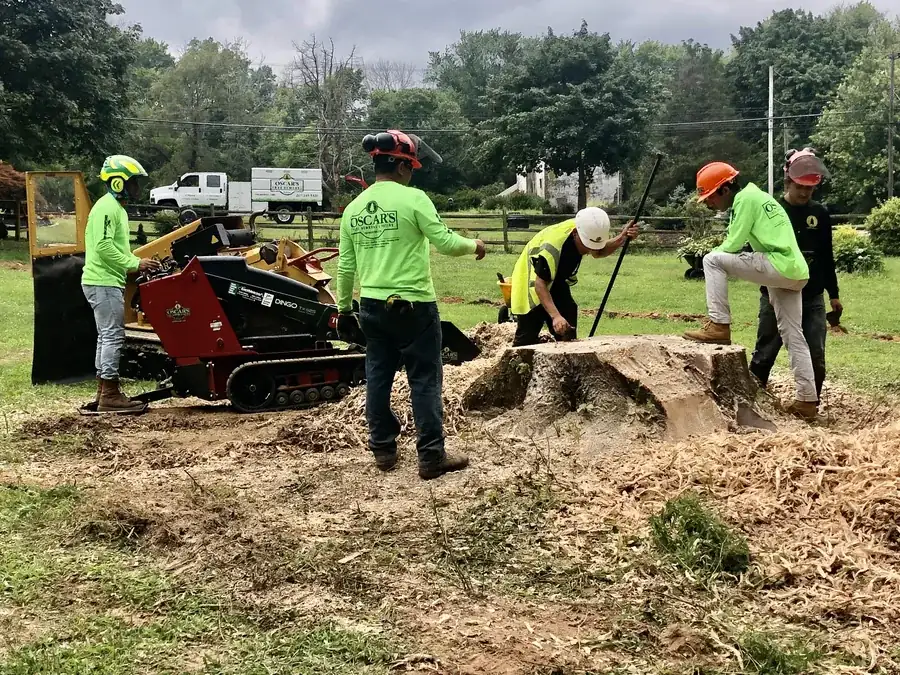
Oscar's Tree Removal & Stone Veneer provides professional stump grinding throughout Bucks County, Montgomery County, and the Lehigh Valley. We grind 6 to 12 inches below grade using commercial-grade equipment - deep enough that you can fill the area, seed or sod over it, lay pavers, or build over the spot without the stump interfering. When we're done, the grind area is clean and the decision about what to do with the space is yours.
Stump grinding is available as an add-on to tree removal - same crew, same visit, lower combined price - or as a standalone service for stumps left behind by previous crews, storm failures, or old removals that were never fully addressed. We price by stump diameter and site access, provide upfront written estimates, and don't charge extra for the things other companies nickel-and-dime. For a full breakdown of what to expect, see our stump grinding cost guide for Bucks County.
We've ground stumps throughout the region since 2016. We know how hardwood stumps in Bucks County compare to softwood stumps. We know how ash stumps from EAB removals behave. We've worked in tight backyards, through fence gates, beside driveways and foundations, and on hillside lots. Call for a free estimate - we'll tell you exactly what it costs and what you'll be left with.
6 Reasons to Stop Ignoring That Stump
Mowing Hazard Eliminated
Stumps at grade are a blade and deck destroyer. Grinding removes the obstacle so you can mow cleanly across the entire yard.
Pest Harborage Removed
Decaying stumps attract carpenter ants, termites, and other wood-boring insects. Those pests don't stay in the stump - they migrate to nearby structures.
No More Sprouting
Many species continue sending up shoots from the root system after the trunk is gone. Grinding below grade stops the growth cycle permanently.
Curb Appeal Restored
A stump in the front yard reads as unfinished. Grinding and filling allows full lawn restoration - or replanting with something that fits your landscape plan.
Property Value Protected
Stumps visible during a home sale can flag deferred maintenance to buyers. Grinding is a small investment that removes a potential negotiating point.
Future Use Unlocked
Ground below grade, the area is ready for lawn, sod, garden beds, hardscape, or construction. Nothing is built over a stump - grinding gives you options.
The Stump Grinding Process - Step by Step
Free On-Site Estimate
We assess stump diameter, wood type, root structure, and site access. You get upfront written pricing before we schedule anything.
Utility Mark Call (811)
Before any grinding, we call PA One Call (811) to mark underground utilities in the grinding zone. This is standard and non-negotiable - no exceptions.
Site Prep
We clear rocks and debris within the grinding radius, protect nearby lawn and landscaping, and position the grinder for optimal access and chip containment.
Grinding Below Grade
The grinder works through the stump and surface roots in layers, cutting 6 to 12 inches below grade depending on your planned use of the area.
Chip Management
Wood chips are left in the void, spread as mulch, or hauled away - your choice. We discuss this before we start so everything is ready when grinding is done.
Cleanup & Handoff
Work area left clean. We walk you through what's left - depth achieved, fill recommendations, and next steps for lawn restoration or replanting.
Stump Grinding vs. Full Stump Removal
Stump Grinding
- Grinder reduces stump to chips below grade
- Root system remains and decomposes naturally
- Fast - most stumps done in under an hour
- Minimal ground disturbance
- Ready for fill, seed, sod, or hardscape
- Lower cost than full excavation
- Right for 95% of residential situations
Full Stump Removal
- Entire root ball excavated from ground
- Large hole requires significant fill and grading
- Heavy equipment - risk of lawn and landscape damage
- Higher cost and longer project time
- Required for pool or foundation excavation
- Required when root system must be fully cleared
- Rarely necessary for standard residential use
What to Do With the Area After Stump Grinding
Once the stump is ground, you have a void - typically 6 to 12 inches deep and the width of the original stump plus any surface roots we hit. How you fill and finish it depends on what you want to do with the space.
For lawn restoration, fill with topsoil (add more than looks right - it will settle by 20 to 30%), tamp it down, and seed or sod over the area. Water consistently for the first few weeks while the seed establishes. Surface roots that were ground will decompose naturally underground over one to two seasons.
If you're replanting a tree in the same spot, wait at least one full growing season for the remaining root material to break down. Planting too soon means the new tree is competing with decomposing organic material that can affect soil chemistry and drainage.
For hardscape - pavers, a patio, a shed pad - fill the void with compactable gravel base rather than topsoil, which will settle and shift under load. Compact in lifts before setting any surface material. If the stump was large and we ground deep, flag the area for your contractor so they can account for it in their base prep.
Lawn Restoration
Fill with topsoil, seed or sod, water for 2-3 weeks until established
Replanting
Wait one season for decomposition, then plant new tree or shrubs
Garden Bed
Fill with amended topsoil, plant annuals or perennials over the area
Hardscape
Fill with compactable gravel base, compact in lifts before paving
Mulch Area
Spread the grinding chips as mulch around nearby landscape beds
Leave It
Chips decompose in the void - top-dress with soil and seed when ready
Stump Grinding After EAB Tree Removal - Why It Matters
The Emerald Ash Borer has hit Bucks and Montgomery County hard. Ash trees throughout the region have been removed at a rate we haven't seen before, and in most cases the stump is left behind - either because the homeowner didn't budget for it at removal time or because the original crew didn't offer grinding as part of the job.
EAB stumps are worth grinding promptly, and not just for the usual reasons. EAB larvae can persist in the stump and surface root tissue for a period after the tree is removed. In areas with nearby healthy ash trees - neighboring properties, street trees, adjacent lots - that remaining larval population represents a continued spread risk. Grinding destroys the remaining breeding material and eliminates the risk.
From a pure property standpoint, ash stumps also tend to throw vigorous sprouts from the remaining root system. An ash tree that's been cut down and left with roots intact will often produce dozens of fast-growing shoots from the root collar. Grinding below grade stops that growth cycle and means you're not fighting new ash sprouts every season.
If you had an ash tree removed in the last year or two and the stump is still sitting there, call us. We'll give you a straightforward estimate and get it handled. It's a quick job and one less thing on your list.
Why Grind EAB Stumps Promptly
- EAB larvae can survive in stump tissue after tree removal
- Remaining larvae risk spread to nearby healthy ash trees
- Root system produces vigorous sprout growth if left intact
- Stump becomes pest harborage as wood decays
- Grinding removes all of the above in a single visit
- Protects neighboring properties and street trees
Stump Grinding Service Areas - Bucks, Montgomery & Lehigh Valley
When You Call Oscar’s, Here’s What Happens
The most common complaint about tree companies is simple: nobody calls back, nobody shows up, and the yard is a mess afterward. Here is how Oscar runs every job instead.
Oscar Answers the Phone
Call (267) 245-5320 and you talk to the owner, not a call center.
Fast, Free Estimates
Same day in most areas, with a written price before any work starts.
Oscar Is on Every Job
He leads his own crew on site. No subcontractors, ever.
Your Property Protected
We plan the drop zone and protect your lawn, gardens and hardscaping.
Complete Cleanup
Limbs and debris hauled away. Keep the wood if you want it.
Bilingual Crew
English and Spanish on every job, so nothing gets lost.
Why Choose Oscar's for Stump Grinding
240+ Five-Star Reviews
5.0 rating across 240+ Google reviews. Our stump grinding is part of the same service standard that earned those reviews.
Upfront Pricing
Written estimate before any work begins. No surprise charges for chips, cleanup, or equipment setup. What we quote is what you pay.
Licensed & Fully Insured
Full liability and workers' compensation on every job. We call 811 before every grind - underground utilities are marked before we touch the ground.
Commercial-Grade Equipment
We don't show up with undersized equipment and make multiple passes to compensate. Our grinders handle large hardwood stumps efficiently in a single visit.
Family-Owned Since 2016
Oscar built this business. You get an owner-operated crew that takes the quality of every job personally - not a subcontractor who doesn't know you.
Bilingual Crew
English and Spanish. Clear communication throughout the job - nothing is lost between what we discussed on the estimate and what happens on the day.
Stump Grinding FAQ - Bucks County, PA
How deep do you grind stumps?
We grind 6 to 12 inches below grade - deep enough to fill, seed, sod, lay pavers, or build over. The depth depends on your intended use: basic lawn restoration needs about 6 inches, while construction or hardscape installation may require deeper grinding to clear the root mass.
How long does stump grinding take?
Most single stumps take 30 to 60 minutes depending on diameter, wood hardness, and root structure. A large oak or maple may take longer than a smaller ash or ornamental tree. Multiple stumps on the same property are handled efficiently in a single visit.
Is stump grinding better than full stump removal?
For nearly every residential situation, yes. Full stump removal requires excavating the entire root ball - it's expensive, time-consuming, and leaves a large hole that requires significant fill and grading. Stump grinding is faster, cleaner, and achieves the same practical result for replanting, lawn restoration, or hardscape. The exception is major excavation for a pool, foundation, or septic system where roots must be completely cleared.
Will stump grinding damage my lawn or nearby landscaping?
No. The grinder works within the stump's footprint - it doesn't disturb surrounding lawn or landscaping. There will be wood chips and disturbed soil in the immediate grinding area, but adjacent grass, garden beds, and structures are left undamaged. We protect driveways and hardscape during equipment access.
What happens to the wood chips after grinding?
You have three options. Most homeowners leave the chips in the hole - they settle and decompose over time, and you can top-dress with topsoil and seed or sod over them. We can also spread the chips as mulch around your landscaping. Or we can haul everything away completely, leaving a clean void ready for fill. Just let us know your preference before we start.
Do I need to do anything to prepare for stump grinding?
Clear the area around the stump of rocks, decorative edging, and any items that could be damaged by flying chips. If the stump is in a gated area, measure the gate width and let us know - our grinder fits through most standard gates. We'll call PA One Call (811) before grinding to mark any underground utilities in the area.
Can you grind stumps in tight or hard-to-reach areas?
Yes. Our equipment fits through standard fence gates and we regularly work in tight backyards, between garden beds, and close to driveways, foundations, and neighboring structures. We assess access during the free estimate and plan accordingly.
How much does stump grinding cost in Bucks County?
Pricing depends on stump diameter, wood type (hardwood vs. softwood), depth required, and site access. We provide upfront written pricing after a free on-site estimate - no surprises. Multi-stump jobs are priced per stump at a lower rate than single-stump calls.
What should I do with the area after stump grinding?
Fill the void with topsoil (add more than you think - it settles), tamp it down, and seed or sod over it. Water regularly for the first few weeks. If you plan to replant a tree, wait at least a season for the remaining root material to break down. For hardscape, fill with compactable gravel base before setting pavers or concrete.
Do you grind stumps left from Emerald Ash Borer tree removals?
Yes. We've removed and stump-ground hundreds of EAB-affected ash trees throughout Bucks and Montgomery Counties. Ash stumps from EAB removals should be ground promptly - the remaining root system can still harbor EAB larvae for a period after the tree comes down, and early stump grinding reduces the risk of spread to nearby healthy ash trees.
Ready to Get That Stump Gone?
Free on-site estimates throughout Bucks County, Montgomery County, and the Lehigh Valley. Commercial-grade grinding, upfront pricing, no surprises.
Get Your Free Stump Grinding Estimate
Fill out the form and we'll be in touch to schedule your on-site visit. No obligation, no pressure.