Stone Veneer Installation & Repair in Bucks County, PA
Retaining walls, foundations, steps, columns, fireplaces, and full exteriors. Natural and manufactured stone. Family-owned crew that does the job right - backed by the only written 10-year warranty offered by any stone veneer contractor in the area.
The Look of Full Natural Stone. A Fraction of the Weight and Cost.
Stone veneer is a thin layer of real or manufactured stone - typically 3/4 to 1.5 inches thick - applied to a wall, retaining wall, foundation, column, or other structure to give it the appearance and texture of full-depth masonry. It weighs a fraction of what full stone would, installs faster, and can be applied to virtually any properly prepared surface, interior or exterior.
Done right, it looks identical to full stone construction. Done wrong, it cracks, delaminations, and lets water in behind it - leading to serious structural damage in a few Pennsylvania winters. The difference between a veneer installation that lasts decades and one that fails in five years is almost entirely in the prep work: the substrate, the waterproofing membrane, the scratch coat, and the mortar quality.
Oscar's has been installing and repairing stone veneer throughout Bucks County since 2016. Every job is done by our own crew - no subcontractors. We follow MVMA installation standards on every project and back the work with a written 10-year warranty, the only one offered by any stone veneer contractor in this area.
Get a Free EstimateA written 10-year workmanship warranty on every installation. We go over the full terms with you at your estimate.
Family-owned since 2016. We know how Pennsylvania's freeze-thaw cycles behave, which local stone suppliers to trust, and what substrate conditions look like in the homes of this region.
Every stone veneer installation and repair is done by our own trained, bilingual crew. No strangers from a labor app. The people who show up are the people we stand behind.
Natural thin stone, manufactured veneer, fieldstone, limestone, Pennsylvania bluestone, and flagstone. We bring samples to your estimate so you can see options in context before choosing.
Stone Veneer Applications We Handle in Bucks County
Stone veneer works on nearly any properly prepared surface - interior or exterior, residential or commercial. Here are the eight applications we install most often across Bucks County and Montgomery County.
Retaining Walls
Stone veneer faced over block or poured retaining walls is one of our most-requested services. We ensure proper drainage and weep holes before setting any stone, so hydrostatic pressure never builds up behind the facing. The result is a structurally sound wall that looks like natural fieldstone or stacked ledgestone.
Foundation Facing
Above-grade foundation walls and visible basement exposure are perfect candidates for stone veneer. It protects parged or exposed block from weathering while transforming what is typically the most visually neglected part of a home. We flash and waterproof the base course to handle ground-level moisture and freeze-thaw exposure.
Steps & Stairs
Stone veneer on concrete steps and stair risers gives entry approaches a permanent, high-end look. We use a higher-strength mortar mix and ensure proper bonding and drainage for any horizontal surfaces exposed to rain and ice. Bluestone and natural fieldstone are particularly popular choices for this application.
Columns & Pillars
Entry columns, porch pillars, mailbox posts, and decorative structural columns finished in stone veneer add architectural permanence that vinyl and wood wraps simply can't replicate. We work around both round and square forms, and we flash column tops to prevent water from entering at the cap joint.
Fireplace Surrounds
Interior and exterior fireplace surrounds and hearths are among our most satisfying projects. A stone fireplace surround completely transforms a room - floor to ceiling in natural or manufactured stone. We use heat-rated mortar where required and protect your flooring and furniture throughout the installation.
Garden Borders & Landscape Walls
Raised planter beds, garden borders, and decorative landscape walls faced in fieldstone or cobble create a cohesive, intentional look throughout your property. These smaller-scale projects are often completeable in a single day and add immediate curb appeal and resale value.
Commercial Facades
We install stone veneer on retail storefronts, office building entries, restaurant facades, and commercial properties throughout Bucks County. Stone creates a premium first impression and requires far less ongoing maintenance than paint or stucco. We work around your business hours and minimize disruption to operations.
Repair & Repointing
Loose stones, failed mortar joints, cracked faces, and water-damaged sections. We diagnose the root cause - not just the symptom - and repair it correctly so it doesn't recur. Repointing replaces deteriorated mortar before water works further behind the veneer. Small repairs now prevent full replacements later.
Natural & Manufactured Stone Types We Install
We work with six primary stone categories, each with its own character, durability profile, and best-use applications. We bring samples to your estimate so you can see how each looks against your home before committing.
Natural Thin Stone Veneer
Actual quarried stone - granite, sandstone, or quartzite - sliced to 3/4-1.5 inches thick. Each piece is genuinely unique in color and character. Weighs less than full-depth stone but delivers the same authentic look and feel. Lasts generations when properly installed. Best for premium exterior applications where authenticity matters most.
Manufactured Stone Veneer
Concrete cast in stone molds, tinted to replicate natural stone. Consistent sizing reduces labor cost and speeds installation. Manufacturer warranties typically run 25-50 years. A wide range of profiles available - ledge, fieldstone, cobble, stacked - at a lower price point than natural stone. Great choice for budget-conscious projects without sacrificing the look.
Pennsylvania Fieldstone
The defining material of historic Bucks County farmhouses and stone walls. Irregular, rustic, and timeless - no two installations look alike. We source local fieldstone from regional quarries and sort for color consistency. Ideal for retaining walls, foundation facing, and any application where you want an authentic Pennsylvania farmhouse aesthetic.
Limestone
A warm, light-toned sedimentary stone with a refined, classic appearance. Limestone is highly workable, which means it can be cut to precise dimensions and set in tight, clean coursing patterns. Popular for formal home exteriors, fireplace surrounds, and columns. Slightly more porous than granite, so sealing is recommended for exterior applications in PA's wet climate.
Pennsylvania Bluestone
The regional classic - a dense, hard flagging stone quarried in northeastern Pennsylvania and the Delaware Water Gap area. Naturally frost-resistant and ideal for the Bucks County climate. Works particularly well for steps, landing areas, and low horizontal applications. Its blue-grey tones complement both traditional and contemporary architecture. Extremely long-lived when properly installed.
Flagstone
Thin, flat, irregular stone pieces - often bluestone, slate, or sandstone - set in a mosaic-like pattern. More commonly associated with patios and walkways, but flagstone veneer on low retaining walls and garden features creates a distinctive, organic look. The irregular joints and varied piece sizes give flagstone installations a handcrafted character that uniform manufactured profiles cannot replicate.
Our Stone Veneer Installation Process
No shortcuts, no skipped steps, no surprises after the estimate. Here's exactly how we go from first call to finished installation - and why each step matters for a result that lasts.
On-Site Assessment & Estimate
We come to your property, assess the substrate and surface condition, identify any prep work or repairs needed, and discuss stone options. You receive a clear written estimate with a fixed price - most within the same or next day. No vague range quotes.
Stone & Material Selection
We bring physical samples of stone types and colors so you can compare options in context - against your home's siding, brick, paint color, and landscape. We discuss coursing patterns, joint profiles, and mortar color. You make the call; we execute your vision.
Surface Preparation
This is the step competitors skip. We clean and prepare the substrate, install water-resistive barrier on wood-framed walls, apply metal lath where required, and apply a scratch coat. On masonry substrates, we check for soundness and moisture. The prep is where the warranty gets earned.
Stone Installation
We set stone in the agreed pattern using the correct mortar mix for the application - cold-weather admixtures when temperatures require, heat-rated mortar for fireplace applications, higher-strength mixes for retaining walls and steps. Every course is checked for level and alignment.
Grouting, Jointing & Finishing
Mortar joints are tooled to the agreed profile - raked, brushed, or tight - for the correct look and water-shedding performance. We clean stone faces of mortar smear as we go. Cap stones, sill flashing, and trim details are addressed before we call the work complete.
Final Walkthrough & Warranty
We walk you through the completed installation, review the work together, and hand you the written 10-year warranty document before we leave. We also cover any specific maintenance recommendations for your stone type and explain what to watch for in the first few seasons.
Eight Reasons Bucks County Homeowners Choose Oscar’s for Stone Veneer
Every stone veneer contractor in this area will tell you they do good work. Here's what actually separates us.
Written 10-Year Warranty
Every installation comes with a written 10-year workmanship warranty, and you receive the document before we pack up.
No Subcontractors. Ever.
Every installation and repair is done by our own crew - the people we trained and stand behind. We never farm out jobs to unfamiliar labor. When you hire Oscar's, the crew on your property is Oscar's.
We Don’t Skip the Prep
Substrate preparation - waterproof barrier, scratch coat, lath on wood frames - is where veneer installations succeed or fail. It's also where corners get cut to win bids. We don't cut those corners. Our warranty depends on it.
Honest Estimates, Fixed Prices
We give you a written price at the estimate. What we quote is what you pay. No change orders mid-job because we "found something" after we started. If we see a potential issue, we tell you upfront and include it in the estimate.
PA Climate Experience
Bucks County sees dozens of freeze-thaw cycles every winter. We know how that affects mortar, waterproofing, and stone movement over time. Our installations are built for this climate - not just for how they look on installation day.
Repair vs. Replace Honesty
We'll tell you if your existing veneer needs repair or full replacement - and give you the honest answer, not the more expensive one. Small repairs now often prevent major replacement costs later, and we'd rather you be a satisfied repeat customer than an oversold one.
Bilingual Crew
Our crew is bilingual - English and Spanish. Communication on the job site is clear in both languages, which reduces errors and keeps the project on track. We can also work directly with Spanish-speaking homeowners.
Same-Day Estimates
We respond fast. Most estimate requests are scheduled same or next day. We bring stone samples, assess the surface, answer your questions, and leave you with a written price. No weeks-long wait to find out what your project will cost.
Chimney, Columns & a Covered Patio in Stone Veneer
One of our larger recent stone veneer jobs: a two-story chimney wrapped from the deck line to the cap, the exterior walls of a covered patio, an outdoor fireplace surround, and the support columns. Here is the job site on video, plus photos from the install.
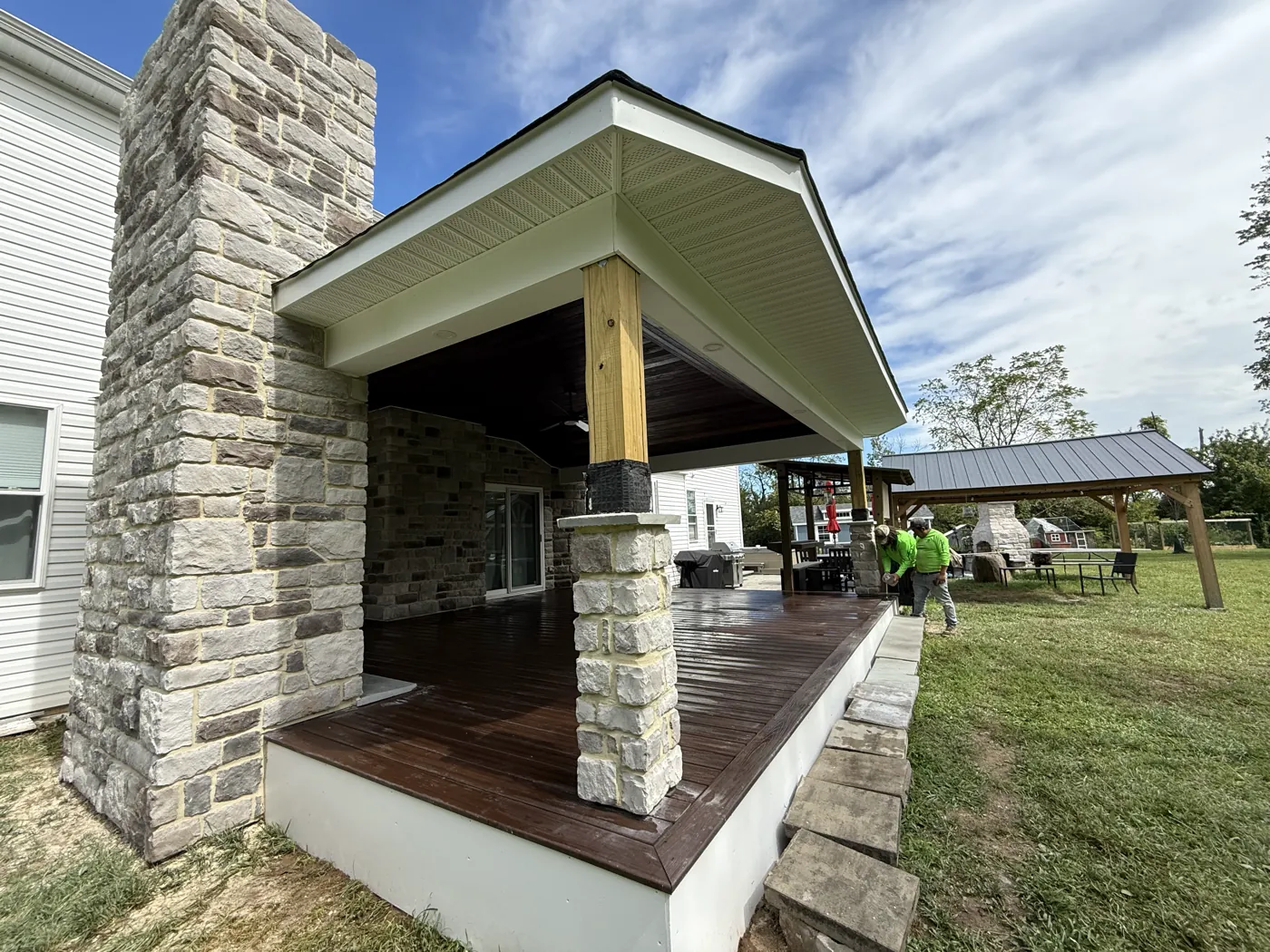
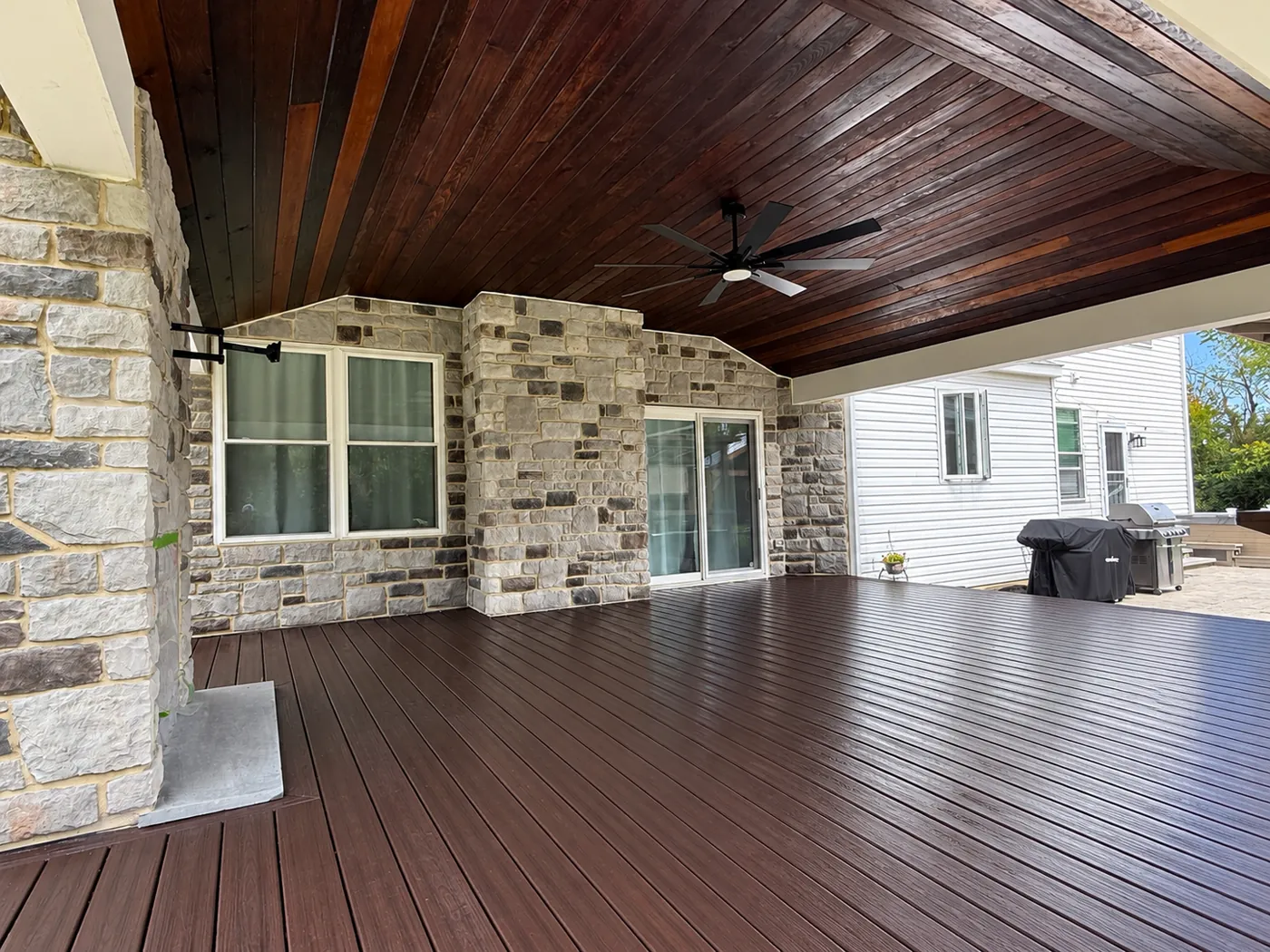
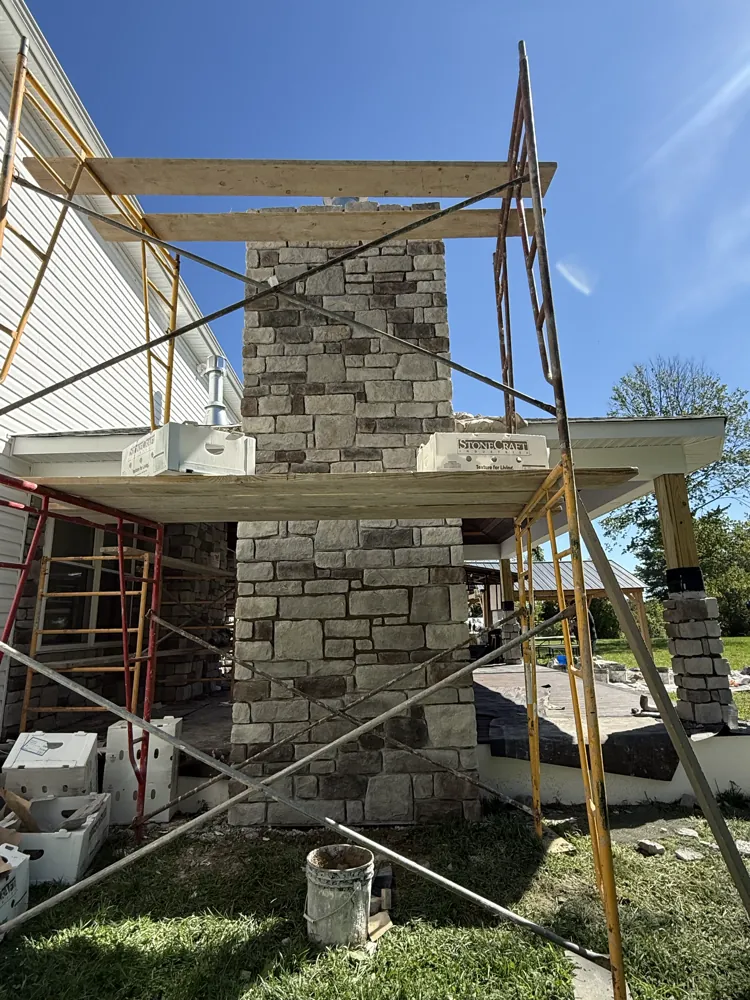
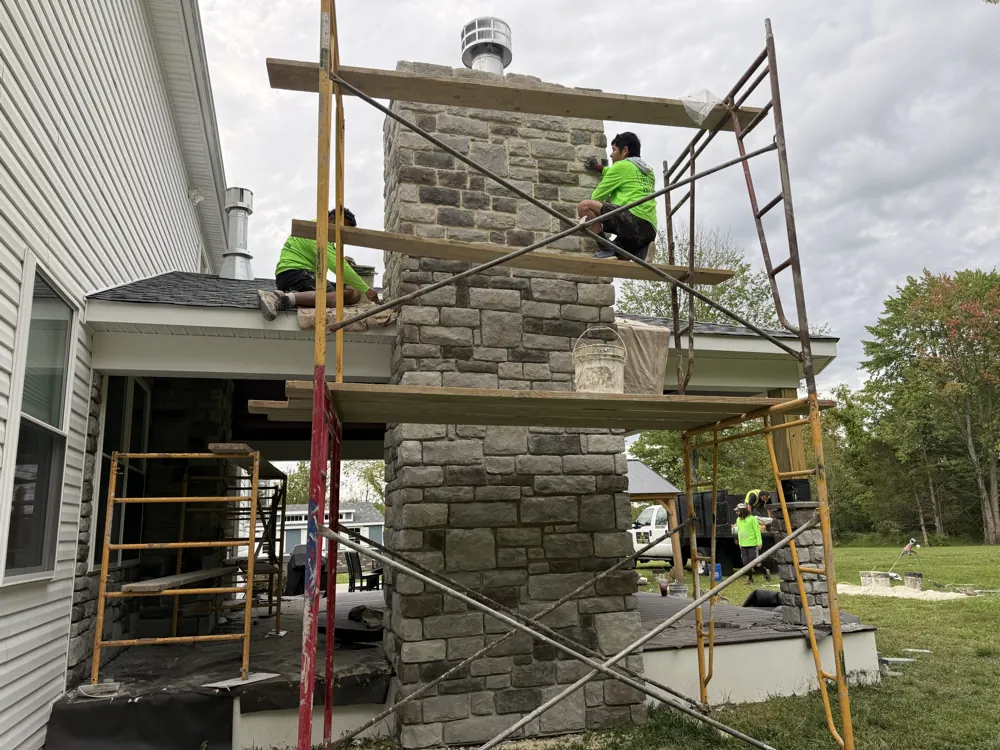
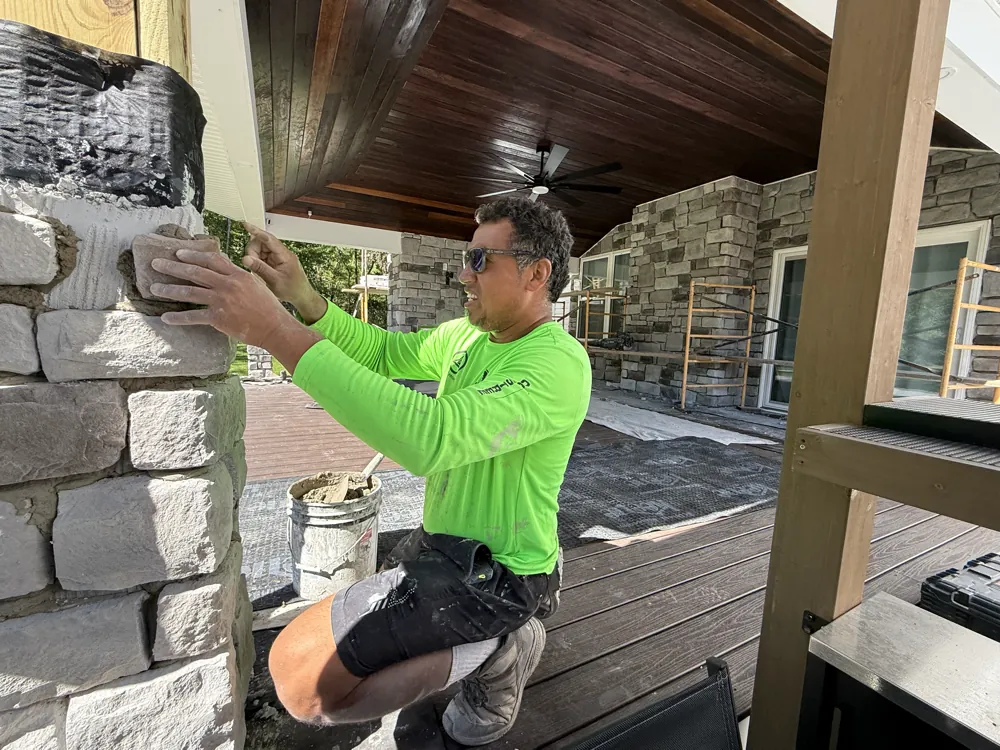
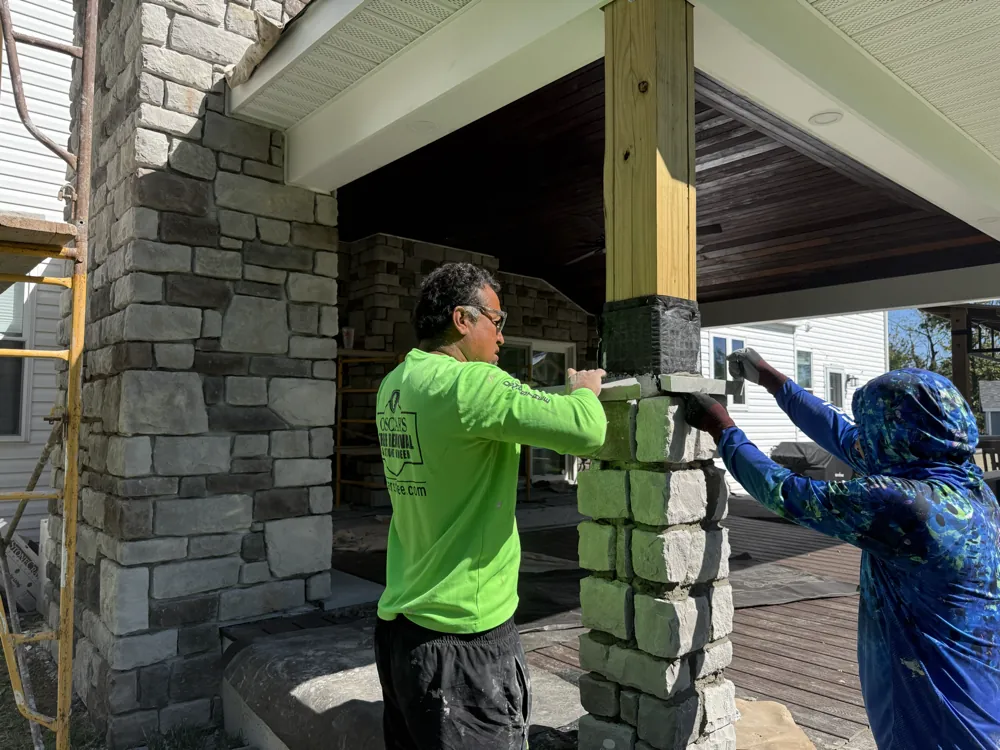
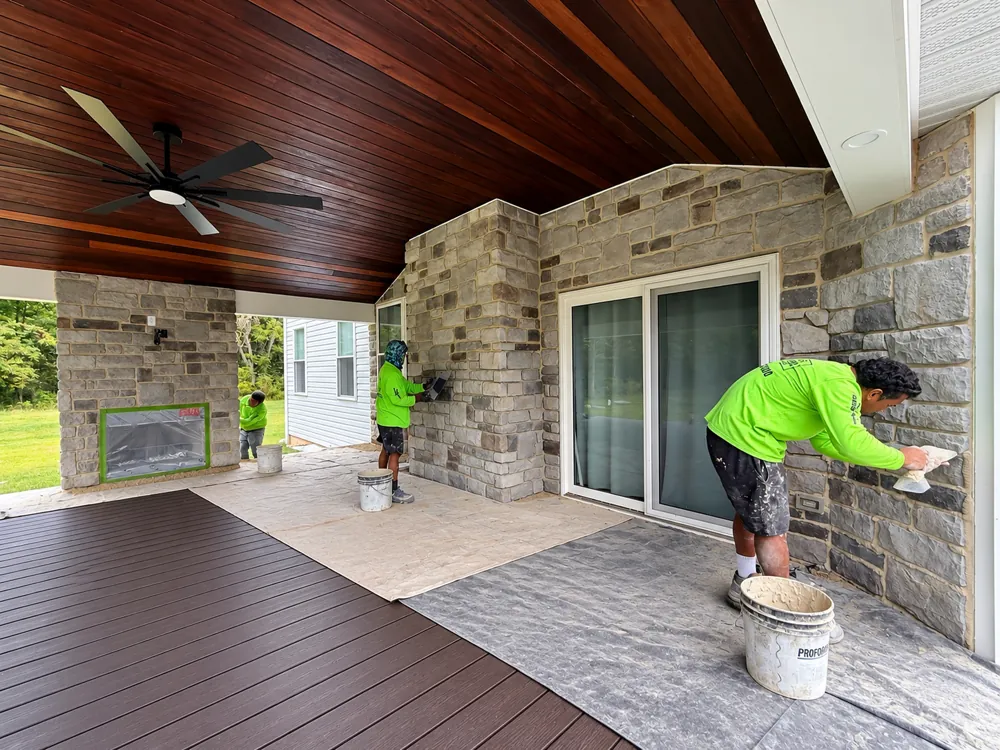
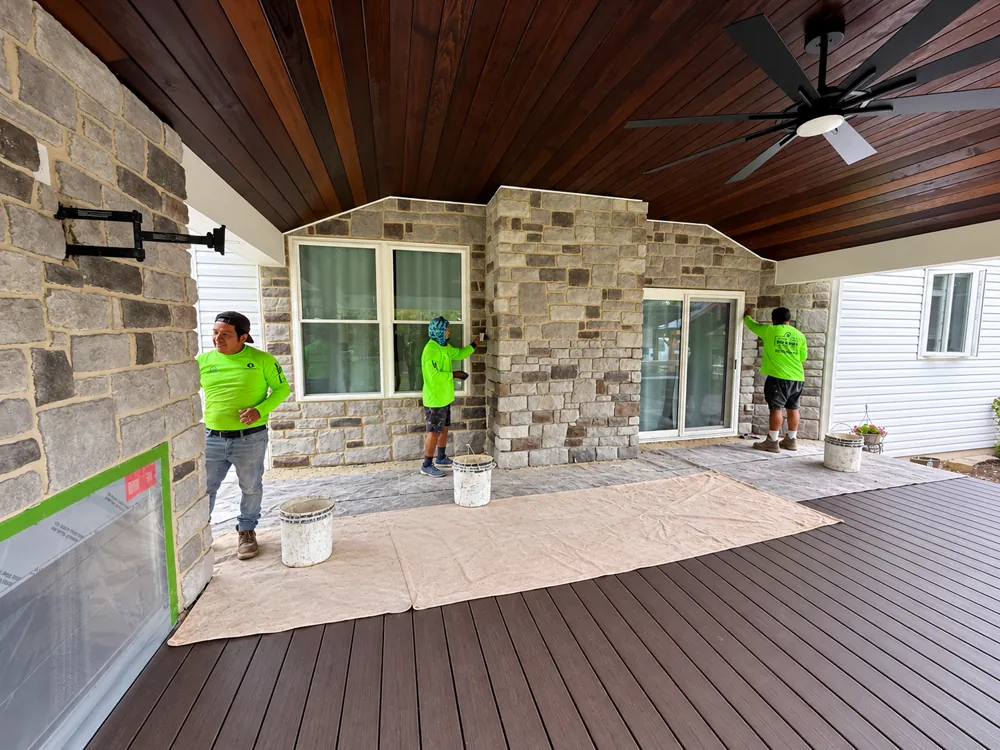
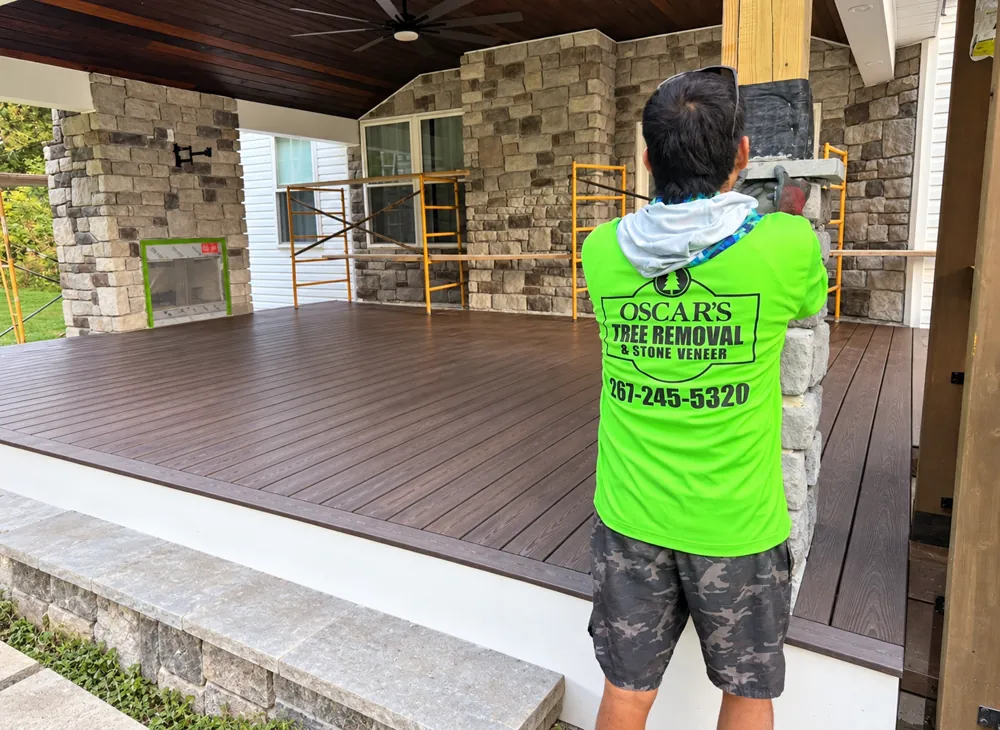
Stone veneer is set by hand, course by course, over a prepared substrate. On a chimney this tall that means working off scaffolding and keeping the coursing consistent the whole way up. Want something similar priced out? Get a free estimate or call (267) 245-5320.
Types of Stone Veneer Projects We Handle
From single-day fireplace surrounds to multi-day retaining wall facing projects, here's the range of work our crew handles throughout the region.
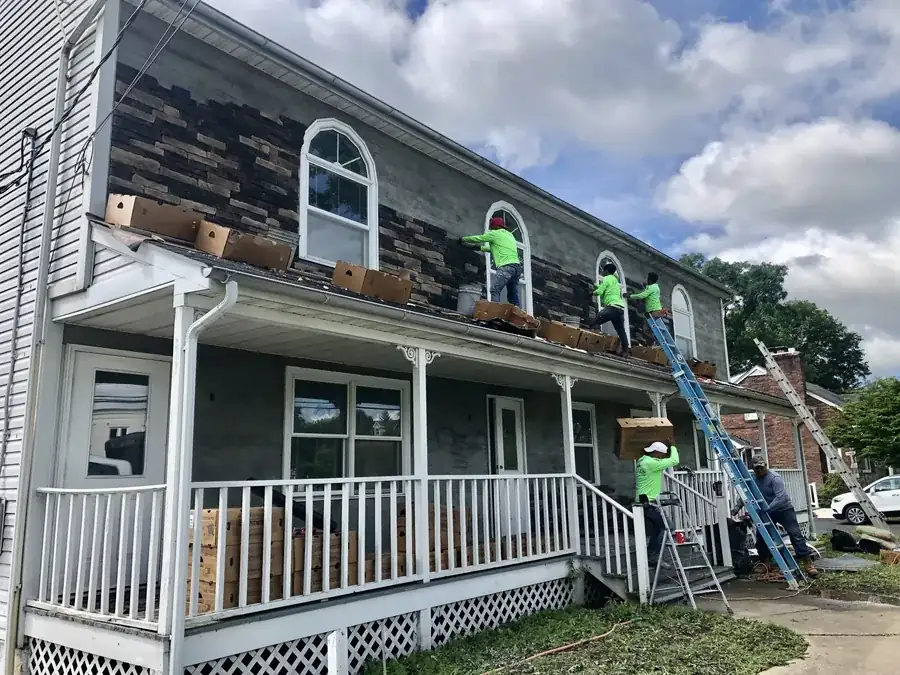
Exterior Stone Veneer
Stone veneer on a home's front foundation, walls, and entry accents, chosen to suit the style of the house.
Foundation & ColumnsRetaining Wall Facing
Plain block retaining walls faced in natural or manufactured stone, with drainage checked before the stone goes on.
Retaining Wall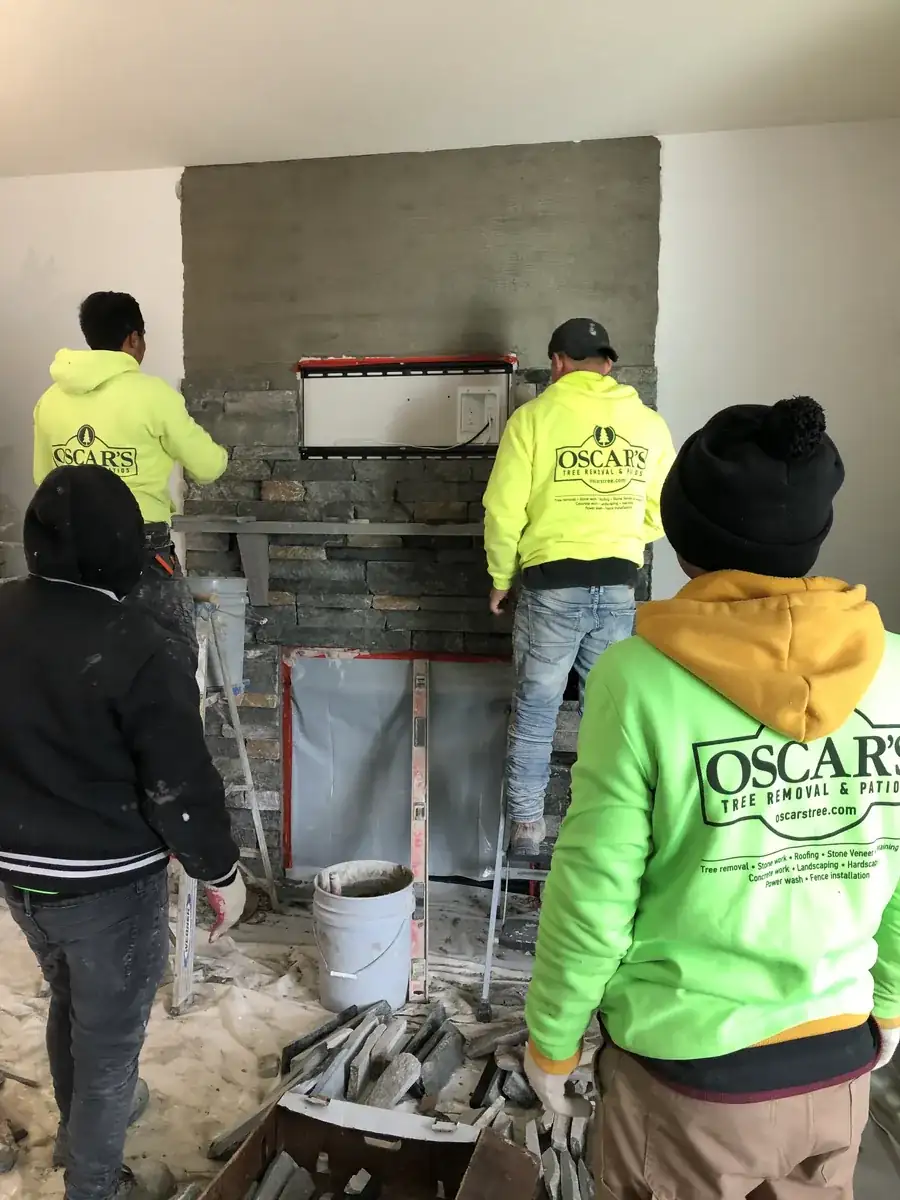
Interior Fireplace Surround
Stone veneer on interior fireplace surrounds and accent walls. Many fireplace jobs are finished in a day or two.
Fireplace SurroundEntry Steps & Landings
Stone on concrete steps and landings, set to handle foot traffic and Pennsylvania winters.
Steps & LandingEntry Columns & Pillars
Stone veneer on porch columns, pillars, and mailbox posts, with tops capped to keep water out.
Columns & Pillars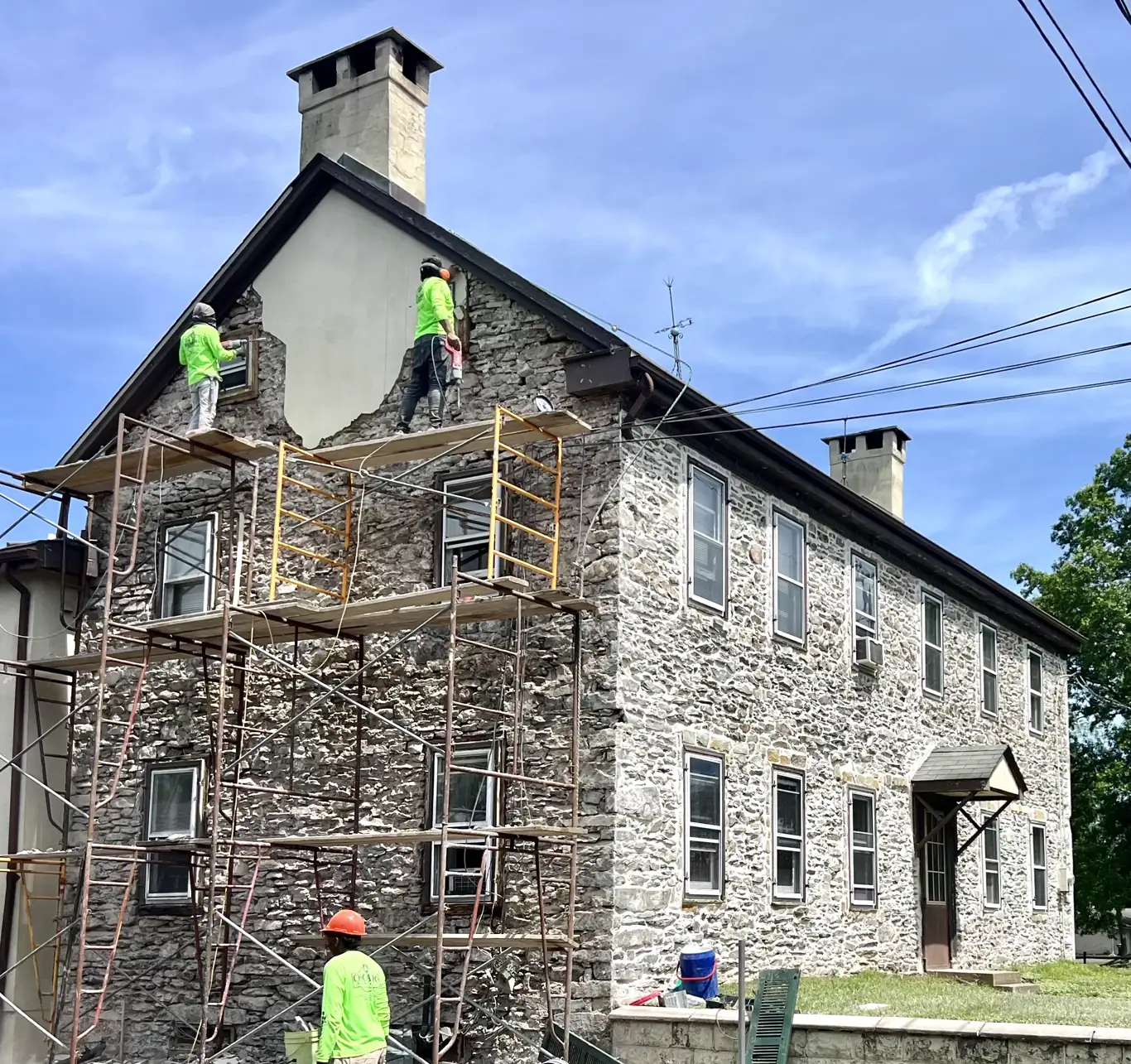
Stone Veneer Repair & Repointing
Repointing failed mortar joints and re-setting loose stones on older installations, matched as closely as possible to the existing work.
Repair & RepointingStone Veneer Installation & Repair Across Bucks & Montgomery Counties
Oscar's is based in Dublin, PA on Route 313 in central Bucks County. We serve the full county - from Quakertown in the north to Bristol in the south, from Newtown in the east to Perkasie in the west - as well as the adjoining townships of Montgomery County.
For larger projects, we travel into the Lehigh Valley as well. Call us to confirm your location. If we can get there and do the job right, we will. We don't turn away good work because of an extra 20 minutes of drive time.
Because we work across Bucks County every week, we know the local municipalities, permit requirements, and the materials that hold up best in this specific regional climate. That local knowledge matters more than it might sound - the stone that performs well in coastal climates is not always the right choice for a Pennsylvania township that sees dozens of freeze-thaw cycles every winter.
Schedule a Free EstimateBucks County
- Dublin (home base)
- Doylestown
- New Hope
- Newtown
- Quakertown
- Perkasie
- Sellersville
- Warminster
- Southampton
- Bristol
Montgomery County
- Lansdale
- North Wales
- Hatfield
- Horsham
- Souderton
- Telford
- Ambler
- Chalfont
- Montgomeryville
- Line Lexington
Don’t see your town? Call to confirm - we likely serve it.
(267) 245-5320Stone Veneer Installation & Repair Near You
We've built dedicated guides for the communities we serve most. Find your area for local pricing, neighborhood-specific angles, and what to expect in your market.
Stone Veneer in Perkasie, PA
5 minutes from our Dublin shop. Retaining walls, foundation facing, and historic borough property work throughout Perkasie, Sellersville, East & West Rockhill.
View Perkasie PageStone Veneer in Doylestown, PA
Historic borough character, HARB-aware installation, retaining walls throughout Doylestown Borough and Township. Natural stone where it matters most.
View Doylestown PageStone Veneer in Quakertown, PA
Fieldstone farmhouse repointing and repair throughout Richland, Milford, and Haycock townships. New installation on rural lots and Lake Nockamixon properties.
View Quakertown PageStone Veneer in Warminster, PA
Mid-century housing stock, foundation facing on ranches and split-levels, retaining walls throughout Warminster Township and surrounding communities.
View Warminster PageStone Veneer in Lansdale, PA
Foundation facing on North Penn corridor homes, retaining walls, entry features throughout Lansdale, North Wales, Hatfield, and Montgomery Township.
View Lansdale PageStone Veneer in Souderton, PA
Foundation facing, retaining walls, and agricultural outbuilding features throughout Souderton, Telford, Franconia Township, and Salford Township.
View Souderton PageStone Veneer in Bethlehem, PA
Architecturally significant homes throughout the South Side, West Side, and surrounding Northampton County communities. Natural and manufactured stone.
View Bethlehem PageStone Veneer Repair & Repointing
Failing mortar joints, loose stones, efflorescence, water infiltration. We fix the cause, not just the symptom. Free same-day estimates. 10-year warranty.
View Repair & RepointingFireplace Surround Installation
Custom fireplace surround systems in natural or manufactured stone. Interior and exterior. Full design-to-installation service throughout Bucks County.
View Fireplace SurroundsStone Veneer FAQ - Bucks County, PA
The questions we hear most often from homeowners before they schedule their estimate. Straight answers, no sales spin.
How much does stone veneer installation cost in Bucks County PA?
Stone veneer installation in Bucks County typically runs $18-$30 per square foot for manufactured stone and $30-$50+ per square foot for natural thin stone veneer. Those ranges cover material and installation together. Variables that move the number include: stone type selected, condition and type of the existing substrate (masonry vs. wood frame requires more prep), project height and access complexity, and whether any repair or waterproofing is needed before stone can be set. Small repairs start at a few hundred dollars. A full foundation facing or large exterior accent wall on an average home runs several thousand. We provide free written estimates with exact pricing before any work begins - no surprise costs, no hidden fees after the job starts. For a full cost breakdown, see our stone veneer cost guide for Bucks County. Comparing exterior options? See stone veneer vs. brick vs. stucco. For inspiration, see stone veneer ideas and types.
What’s the difference between natural and manufactured stone veneer?
Natural thin stone veneer is cut from actual quarried stone - fieldstone, bluestone, limestone, granite, or sandstone - sliced to roughly 3/4 to 1.5 inches thick. Every piece is genuinely one-of-a-kind in color, texture, and character. Natural stone costs more and takes more skill to set, but the result has a depth and authenticity that manufactured stone cannot fully replicate. Manufactured stone veneer is made from concrete poured into stone-shaped molds, then tinted to look like natural stone. It's lighter, more consistent in size and profile, and generally 30-50% less expensive than natural stone. Both are durable and attractive. We install both and help you choose based on your budget, the specific application, and which aesthetic fits your home best. We'll bring samples to your estimate.
How long does stone veneer last?
Properly installed natural stone veneer can last 75-100 years or more. You can see examples of 19th-century fieldstone veneer on Bucks County farmhouses still holding up today. Manufactured stone veneer typically carries manufacturer warranties of 25-50 years and performs well for decades with minimal maintenance. The single biggest factor in longevity isn't the stone itself - it's the installation quality. Specifically: proper waterproofing membrane, correct scratch coat and lath on wood-frame walls, and the right mortar mix. Veneer installed without these steps can fail in 5-10 years in Pennsylvania's climate. That's exactly why our 10-year written warranty is meaningful - it signals we got the prep right.
Can stone veneer be installed in winter in Pennsylvania?
Yes, with the right precautions. Mortar must not be applied when surface temperatures are below 40°F, and freshly installed stone must be protected from freezing temperatures for at least 48 hours after setting. Experienced crews work through Pennsylvania winters by warming substrates with heat blankets, using cold-weather mortar additives, and tenting work areas in extreme conditions. We evaluate each project individually and are honest about what's feasible. Some winter jobs are straightforward if temperatures are trending up and nights stay above freezing. Others need to wait for a better window. We won't start a job we can't finish correctly just to keep the schedule moving - we'll tell you plainly at the estimate what timing makes sense.
Do I need a permit for stone veneer installation in Bucks County?
In most Bucks County municipalities, applying cosmetic stone veneer to an existing structure does not require a building permit - it's classified as a finish material change, similar to siding. However, there are exceptions: if the work involves structural modifications, retaining walls over a certain height (which varies by township - often 4 feet), new construction, or a property within a historic district, a permit may be required. Requirements vary by municipality. We recommend confirming with your local township or borough code office before any project begins. We can share what we've observed in the townships we serve regularly and we operate fully within all applicable codes. We'll flag anything that looks like it might need review at your estimate.
How do I know if my stone veneer needs repair vs. full replacement?
Repair is typically the right call when: you have isolated loose or cracked stones in an otherwise sound installation, mortar joints are failing in specific areas but the substrate is dry and intact, the damage is cosmetic or limited to a small section, or the original installation was otherwise done correctly. Full replacement makes more sense when: water has penetrated behind the veneer and damaged the substrate (wet, soft, or rotted backing material is the tell), widespread failure exists across large areas, the original installation was done so poorly - no waterproofing, no scratch coat - that localized repairs won't hold, or the stone profile is no longer available for matching. We'll give you an honest read at the estimate, including photos of what we find and a clear explanation of why one path or the other is the right call.
Can you install stone veneer on a wood-framed wall?
Yes. Stone veneer on wood-framed walls is common and, done correctly, holds for decades. The process requires additional steps compared to masonry substrates: a code-compliant water-resistive barrier is applied over the sheathing, then metal lath is fastened through the sheathing into the studs, then a scratch coat is applied over the lath and allowed to cure. This creates a proper mechanical bond for the veneer mortar while managing moisture. We follow MVMA (Masonry Veneer Manufacturers Association) installation guidelines on every wood-frame job. Skipping any of these layers - which some contractors do to save time - is the root cause of the vast majority of stone veneer failures on residential homes. It's also the reason we don't skip them.
What causes stone veneer to crack or fall off?
The most common causes, in order of frequency: (1) No water-resistive barrier on wood-frame substrates - moisture soaks the sheathing and causes mortar to lose adhesion. (2) Improper or absent scratch coat - stone needs a keyed substrate to bond to; without it, mortar adhesion fails over time. (3) Wrong mortar mix or application to a wet surface - mortar applied too wet, or to a substrate that's too wet, cures incorrectly and doesn't develop full strength. (4) No expansion or control joints on large installations - stone and mortar move slightly with temperature changes; without joints to accommodate that movement, cracks develop. (5) Freeze-thaw water infiltration - Bucks County sees dozens of freeze-thaw cycles every winter; water that gets behind veneer and freezes expands with tremendous force. All of these are preventable with correct installation practice. None of them happen on jobs we do.
How do you maintain stone veneer?
Manufactured stone veneer is very low maintenance. Annual inspection of mortar joints - look for gaps, cracks, or crumbling - is the main task. Clean with a low-pressure garden hose; never use a pressure washer above 500 psi, which strips mortar and forces water behind the stone. Avoid acid-based cleaning products, which degrade mortar chemistry. Keep landscaping, mulch, and soil away from the base of the veneer to prevent moisture retention. For natural stone, particularly porous types like limestone or sandstone, applying a penetrating stone sealer every 3-5 years reduces moisture absorption and staining in PA's wet climate. Address mortar cracks promptly - a half-hour repointing job now costs a small fraction of what the same area costs after water has been getting behind the stone for two winters.
Do you install stone veneer on retaining walls?
Yes - it's one of our most common applications. We face both existing block retaining walls and new construction. On retaining walls, drainage is critical: we confirm weep holes or French drain provisions are in place before setting any stone, so hydrostatic pressure doesn't build up behind the veneer facing. Without proper drainage, water pressure behind a retaining wall will push stone veneer off the face, no matter how well it's set. We've repaired enough of these failures to know it's not a theoretical concern. After drainage is confirmed, we follow the same installation steps as any other project - scratch coat, proper mortar, stone setting, and jointing. We handle retaining wall veneer at all scales, from garden-height landscape walls to full-property grading retaining systems, throughout Bucks County and Montgomery County.
Free Estimates - Backed by a Written 10-Year Warranty
We serve Bucks County and Montgomery County. Call or fill out the form below - we’ll schedule your estimate same or next day, bring stone samples, assess the surface, and hand you a clear written price. No obligation.
Get Your Free Stone Veneer Estimate
Tell us about your project and we’ll be in touch the same day. We’ll come out, bring stone samples, assess the surface conditions, and give you a clear written price - no obligation, no pressure.
Serving Dublin, Doylestown, New Hope, Newtown, Quakertown, Perkasie, Sellersville, Warminster, Lansdale, Hatfield, and all of Bucks and Montgomery Counties.