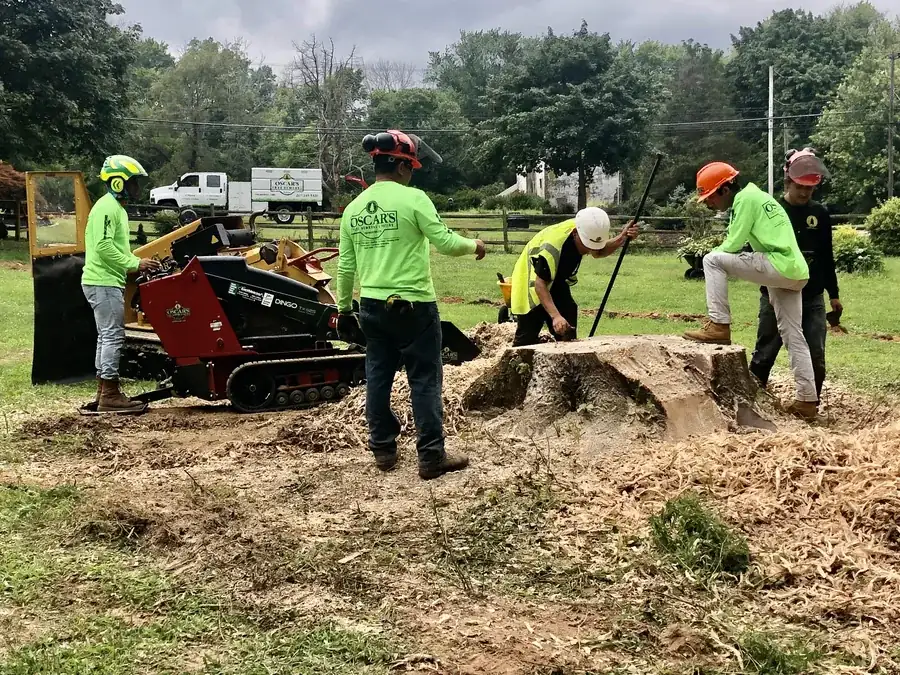
Most stump grinding in Bucks County costs $100 to $150 for a small stump (under 12 inches), $150 to $300 for a medium stump (12 to 24 inches), and $300 to $500 or more for a large stump (over 24 inches). Priced by diameter, that works out to roughly $3 to $5 per inch for the first stump, with a typical minimum charge around $100.
A leftover stump is the one part of a tree job most homeowners forget to budget for. It is almost always quoted separately from the removal, the pricing is based on a measurement most people have never taken (the stump's diameter), and the quotes you get can look very different depending on what is included. This guide breaks down what stump grinding actually costs in Bucks County in 2026, how it is priced, what changes the number, and where you can save.
Stump Grinding Cost by Size in Bucks County
Diameter is the single biggest driver of price. Measure the stump across the widest point at ground level, including the flare where the trunk widens at the base, since that is what the grinder has to chew through. Here is what each size typically runs locally.
| Stump size (diameter) | Typical cost | Notes |
|---|---|---|
| Small (under 12 in) | $100 - $150 | Usually at or near the minimum charge |
| Medium (12 - 24 in) | $150 - $300 | The most common residential range |
| Large (24 - 36 in) | $300 - $450 | Oak and other hardwoods push the high end |
| Very large (36 in +) | $450 - $700+ | Often priced hourly at $100 - $200/hr |
These are honest Bucks County ranges, not a flat rate. Two 20-inch stumps can be priced very differently if one sits in open lawn and the other is wedged against a fence on a slope. Treat this as a planning guide, then get a free on-site estimate for an exact number.
How Stump Grinding Is Priced: Per Inch and Per Stump
Most tree services in Bucks County price grinding by the stump's diameter rather than a flat fee. The going structure looks like this:
- First stump: about $3 to $5 per diameter inch
- Each additional stump on the same visit: about $2 to $3 per inch
- Minimum charge: around $100 (sometimes $80 to $160)
The minimum charge is the part homeowners miss. An 18-inch maple stump at $4 per inch calculates to $72, but because that is below the minimum, you will still pay about $100 to $130. The minimum exists because the biggest fixed cost is simply getting the grinder to your property and setting up, which is the same whether the stump is tiny or medium. That single fact drives almost every money-saving tip later in this guide.
Real Bucks County Stump Grinding Job Examples
Ranges are useful, but real jobs make the pricing concrete. Here are a few representative grinding jobs from across the county.
| The job | Where | Price |
|---|---|---|
| Single 18 in maple stump, open backyard, chips left as mulch | Doylestown | $120 - $150 |
| Three small stumps (8 - 12 in) ground in one visit, chips hauled | Quakertown | $250 - $350 total |
| Large 30 in oak stump beside a patio, tight access, hardwood | Perkasie | $350 - $475 |
| Dead EAB ash stump ground as an add-on during the tree removal | Warminster | $90 - $130 add-on |
Notice the last row. That same ash stump booked as its own separate visit later would have hit the $100 minimum on its own and likely cost more. Bundled into the removal, it became a small add-on.
What Affects Stump Grinding Cost?
Beyond raw diameter, several factors move a quote up or down. Understanding them helps you read a quote and spot why two estimates differ.
- Wood hardness. Oak, hickory, and seasoned ash are dense and slow to grind, pushing toward the top of each range. Softer species like pine or poplar grind faster.
- Number of stumps. More stumps in one visit lowers the per-stump cost because the setup is shared. This is the biggest lever you control.
- Accessibility. A grinder has to physically reach the stump. Standard residential gates around 36 inches, slopes, soft or wet ground, and obstacles like sheds or pools can add cost or require a smaller machine.
- Grinding depth. The standard 6 to 8 inches suits grass. A deeper 12 to 18 inch grind for replanting costs more.
- Surface roots. Grinding large surface roots that radiate from the stump is sometimes extra, since it adds time and area.
- Debris and cleanup. Leaving the chips as mulch is usually included. Hauling them away or backfilling the hole with clean topsoil can be a small add-on.
- Proximity to utilities and structures. Stumps near sprinkler lines, gas or electric lines, foundations, or hardscaping require slower, more careful work.
- Number of visits. A standalone trip carries its own minimum charge. Combining work avoids paying that twice.
Always have underground utilities marked first by calling 811. Grinders cut 6 to 12 inches into the soil, which is exactly where buried lines, sprinkler heads, and invisible-fence wires live. A reputable Bucks County tree service confirms locates before starting.
Stump Grinding vs. Full Stump Removal: Which Costs Less?
These two are often confused, and the difference is mostly about cost and disruption. Grinding chews the stump into chips down to 6 to 12 inches below grade and leaves the deeper roots to decay naturally. Full removal excavates the entire stump and root ball out of the ground.
| Stump grinding | Full stump removal | |
|---|---|---|
| What happens | Ground 6 - 12 in below grade | Whole stump and root ball dug out |
| Typical Bucks County cost | $100 - $500 | $350 - $800+ |
| Mess and disruption | Minimal, leaves chips | Large hole, heavy soil disruption |
| Best for | Most homeowners | Replanting the exact spot, full root removal |
For the large majority of homeowners, grinding is the right call. It is faster, cheaper, and far less disruptive, and the slowly decaying roots left behind cause no problems for a lawn or garden bed. Full removal only makes sense when you specifically need that exact spot cleared to the root, such as for a new foundation, a pool, or replanting a tree in the identical location.
What Is Included, and What Happens After
A standard stump grinding job in Bucks County includes grinding the stump 6 to 12 inches below grade and, in most cases, leaving the resulting wood chips in and around the hole. Here is what to expect afterward.
The roots
Grinding removes the visible stump and the root collar. The wider lateral roots stay in the ground, but with no stump to feed them they slowly starve and decay over the next few years. No stump-killing chemicals are needed, and regrowth is rare.
The wood chips
Grinding leaves a pile of chips mixed with soil that mounds slightly above the hole. You can leave them as free mulch for beds and borders, have the crew haul them off, or have the hole topped with clean topsoil if you want to seed grass. Decide this up front so it is reflected in the quote.
Planting afterward
For grass, a 6 to 8 inch grind topped with soil is plenty. For a new tree in the same spot, ask for a deeper grind, remove the chips, and backfill with fresh topsoil, or simply shift the new tree a few feet over for healthier soil.
Should You Grind a Stump Yourself?
For a single small, soft stump in open ground, a rental grinder at roughly $100 to $190 per day is a reasonable DIY project. Beyond that, the math usually favors hiring a pro. Once you add the rental, fuel, a way to haul the machine, the chip cleanup, and the time, a DIY job on a medium hardwood stump often costs nearly as much as a professional one, with more risk. Stump grinders are powerful machines that throw debris, and hidden rocks, old fencing, or utility lines turn a Saturday project into a hazard. For anything medium-sized, hardwood, near structures, or on a slope, a professional grind is the safer value.
How to Save Money on Stump Grinding in Bucks County
- Bundle it with the tree removal. When the crew is already on site, grinding is often a small add-on rather than a separate trip with its own minimum charge.
- Do all your stumps in one visit. Additional stumps are billed at the lower per-inch rate, so grinding four stumps at once is far cheaper than four separate appointments.
- Leave the chips as mulch. Skipping haul-away keeps the price down, and the chips are useful around garden beds.
- Be honest about access. Clearing a path and confirming gate width ahead of time avoids surprise charges or a wasted trip.
- Get it in writing. Make sure the quote states depth, whether surface roots are included, and whether chips are hauled, so you are comparing the same scope between companies.