Tree Trimming & Pruning in Bucks County, PA - Done Right, Done to Standard
Dublin-based crew serving Doylestown, Perkasie, Sellersville, Quakertown, Warminster, and surrounding Bucks County and Lehigh Valley communities. 240+ five-star reviews. Licensed & insured. ANSI A300 pruning standards. Se Habla Español.
Tree Trimming vs. Tree Pruning - What's the Difference?
Most homeowners use "trimming" and "pruning" interchangeably - and that's fine, because in practice a professional crew handles both during the same visit. But they refer to different goals, and understanding the distinction helps you describe what your trees actually need when you call for an estimate.
Tree trimming is primarily about controlling size and appearance. You trim to clear a roofline, keep a canopy from overhanging a driveway, maintain a neat shape on ornamental trees, or prevent branches from crowding a fence line. It's maintenance work that keeps trees looking managed and prevents overgrowth from becoming a structural problem.
Tree pruning is a more targeted, health-focused practice. You prune to remove dead, diseased, or structurally compromised branches - improving airflow through the canopy, reducing weight on stressed limbs, and eliminating material that could become a hazard in a storm. Proper pruning follows ANSI A300 standards, which specify exactly where cuts should be made so the tree can close wounds efficiently without decay setting in.
In Bucks County, most homeowners need both. We assess what your specific trees require and do the work that actually needs to be done - not the most expensive option, and not the fastest one if speed means doing it wrong.
✂️ Tree Trimming - Controlling Size & Appearance
Clearing rooflines, fences, driveways, and utility lines. Keeping canopy spread within your property. Shaping ornamental trees. Routine maintenance every 3-5 years to prevent overgrowth from becoming hazardous. Primarily aesthetic but with real safety implications when branches encroach on structures.
🌿 Tree Pruning - Health, Structure & Hazard Reduction
Removing dead, diseased, crossing, and structurally weak branches. Improving canopy airflow to reduce disease pressure. Structural pruning for young trees to build strong branch architecture. ANSI A300 cut placement so wounds close cleanly. The work that extends a tree's life and reduces failure risk.
📋 When Do You Need Both?
Almost always. A tree that needs a roofline clearance cut (trimming) almost always has deadwood or crossing branches worth removing in the same visit (pruning). Combining them saves a mobilization cost and produces better results - the crew can see the full picture and address everything at once.
6 Types of Tree Pruning We Perform in Bucks County
Different trees, different problems, different solutions. Here's what each pruning type means and when your trees actually need it.
Crown Thinning
Selective removal of branches throughout the canopy to increase light penetration and airflow without reducing the overall size. Reduces wind resistance in storm events and lowers the risk of fungal disease by improving air circulation. Best for dense, mature trees that are otherwise healthy.
Crown Raising (Canopy Lifting)
Removal of lower branches to increase clearance beneath the tree - for driveways, walkways, sight lines, lawn equipment access, or to let more light reach a lawn below. Removes branches progressively so the tree maintains proper weight distribution as it heals.
Crown Reduction
Reduces the overall height or spread of the canopy by cutting branches back to appropriate lateral growth points. Used when a tree has grown too close to a structure, is top-heavy and storm-vulnerable, or has outgrown its space. Not the same as topping - cuts are made at lateral growth points, not to stubs.
Deadwood Removal
Removal of dead, dying, and detached branches from the canopy. Dead branches fall unpredictably - they're often the first thing that comes down in a storm, and they can fail on a calm day too. Deadwood removal is the single most straightforward hazard-reduction service and should be done whenever dead branches are present above a target (structure, vehicle, walkway).
Hazard Pruning
Targeted removal of specific branches that pose a clear risk - co-dominant stems with included bark, overextended limbs, branches with weak attachments, or material hanging over rooflines and power lines. Goes beyond routine deadwood removal to address structural problems before they fail.
Structural / Formative Pruning
Pruning young trees (5-15 years old) to establish strong branch architecture before problems develop. Removes competing leaders, corrects tight branch angles, and establishes a dominant central stem where appropriate. The most cost-effective tree care you can do - fixing structural problems at 8 years old costs a fraction of what it costs to manage the same problem at 40.
The Best Time to Trim Trees in Bucks County, PA
When you cut matters almost as much as how you cut. Here's what the seasons actually mean for tree trimming decisions in southeastern Pennsylvania.
Late Winter
(Feb - Mid Mar)
The ideal time for most species. Trees are fully dormant, structure is clearly visible with no leaves, and pruning wounds begin closing as soon as spring growth resumes. Pest and fungal activity is at its lowest. This is when we do our most thorough structural work.
Spring
(Mar - May)
Light trimming and clearance work is fine. Avoid heavy pruning on maples in early spring - they "bleed" sap from fresh cuts, which is cosmetically messy but not harmful. Oaks become a concern starting in April (see oak wilt note below).
Summer
(Jun - Aug)
Safe for deadwood removal, hazard branch elimination, and light clearance cuts. Heavy pruning in summer stresses trees by removing foliage actively producing energy. We do summer trimming regularly but keep it targeted rather than comprehensive.
Fall
(Sep - Nov)
Generally the worst time for major pruning cuts. Trees are moving energy back into roots, wounds are slower to close, and many fungal spores are at peak dispersal in fall. Fine for hazard removal and emergency work - avoid scheduling routine pruning for fall if you can push it to winter.
Oak Trees in Bucks County: Never Trim Between April and July
Oak wilt is a lethal fungal disease spread by sap-feeding beetles that are most active April through July in southeastern Pennsylvania. Fresh pruning cuts during this window attract these beetles and can directly introduce the fungus into an otherwise healthy tree. Oak wilt spreads fast - including to neighboring oaks through root grafts - and kills quickly. If you have oaks that need trimming, schedule it between November and March. If a hazard branch must be removed during the high-risk season, we treat the cut surface immediately with wound sealant to reduce beetle attraction.
Signs Your Trees Need Trimming Now
Don't wait for a storm to make the decision for you. These are the warning signs that a tree is overdue for professional attention.
Branches Over the Roofline
Any branch hanging over or rubbing your roof is a direct liability. Branches deposit debris, trap moisture, accelerate shingle wear, and can come down directly onto the structure in a storm.
Dead or Hanging Branches
Dead branches are unpredictable - they don't wait for storms to fall. Any deadwood visible in the canopy, especially over a walkway, vehicle, or structure, should be removed promptly.
Crossing or Rubbing Limbs
Branches that rub against each other create wounds that invite insects and disease. They also develop weak attachment points over time. This is a pruning fix - remove one of the two branches before the problem compounds.
Storm Damage or Hanging Wood
"Widow makers" - partially broken branches still suspended in the canopy - are among the most dangerous tree hazards. After any major storm, walk your property and look up. Anything hanging needs to come down immediately.
Canopy Blocking Light to the Lawn
If your lawn beneath large trees is struggling or dying out, excessive canopy density is likely the cause. Crown thinning and canopy lifting can restore enough light for grass to survive without removing the tree.
Branches Approaching Utility Lines
Branches growing toward or contacting power lines require professional attention before they create an outage or fire hazard. Don't wait until they're touching - the clearance work is easier and safer done early.
How Much Does Tree Trimming Cost in Bucks County?
We publish real price ranges because we think you should know what to expect before you call. These are honest numbers based on what tree trimming actually costs in the Bucks County and Lehigh Valley market.
Tree trimming prices vary based on four main factors: the tree's height, the canopy spread and density, how much clearance equipment has to work within (tight yards, steep terrain, proximity to structures), and how much work actually needs to be done. A large maple on an open lawn costs less than the same size maple overhanging a roof in a tight side yard.
The numbers below reflect single-tree pricing for professionally performed work - not a landscaper running a chainsaw on a side job. ANSI A300 pruning standards, proper equipment, full cleanup, and insurance documentation are included in every job.
We offer volume pricing for multiple trees trimmed in a single visit - combining trees into one mobilization significantly reduces the per-tree cost. Multiple trees are always worth discussing at the estimate.
| Tree Size | Typical Range |
|---|---|
| Small ornamental (under 20 ft) Dogwood, cherry, ornamental pear |
$150 - $350 |
| Mid-sized (20-40 ft) Maple, birch, younger oak |
$300 - $600 |
| Large (40-60 ft) Mature maple, ash, linden |
$500 - $900 |
| Very large (60+ ft) Oak, sycamore, silver maple |
$800 - $1,500+ |
| Access-restricted / near structure Tight yards, roofline work, steep terrain |
Add $150 - $400 |
Local Threats We Watch For During Every Trimming Visit
A trimming visit is also an opportunity to assess what's happening in the canopy. Two threats in particular are active across Bucks County and Lehigh Valley right now that homeowners should know about.
Emerald Ash Borer (EAB) - Active Throughout Bucks County
The Emerald Ash Borer has devastated ash tree populations across Pennsylvania. In Bucks County and Lehigh Valley, ash trees planted along streets and in residential yards through the 1970s and 1980s are now heavily at risk or already infested. EAB larvae feed beneath the bark, cutting off the tree's vascular system - by the time visible symptoms appear in the canopy, the tree may already be in late-stage decline.
During a trimming visit, we assess any ash trees on the property and advise on their condition. Signs of EAB include S-shaped galleries beneath the bark, D-shaped exit holes, crown dieback starting at the top, and heavy woodpecker activity. Infested trees in early stages can still be treated with systemic insecticide. Trees in late-stage decline should be removed before they become an unpredictable hazard - dead ash trees fail fast.
Avoid moving ash firewood or logs long distances - it's one of the main ways EAB spreads.
Spotted Lanternfly - Tree Stress and Secondary Vulnerability
The Spotted Lanternfly (SLF) is established across Bucks County and southeastern Pennsylvania. SLF feeds heavily on tree-of-heaven (Ailanthus altissima) but also attacks over 70 host plants including oaks, maples, black walnut, birch, and fruit trees. Heavy feeding pressure causes weeping, wilting, and sooty mold buildup from the honeydew SLF excretes.
While SLF rarely kills healthy, established hardwoods on its own, repeated heavy infestations stress trees and make them more vulnerable to secondary fungal infections and opportunistic insects. Trees already stressed by drought, soil compaction, or storm damage are at higher risk of significant decline when hit by a heavy SLF population.
Proper pruning that reduces canopy stress - removing deadwood, improving airflow, and maintaining tree vigor - is one of the best things you can do to help established trees withstand SLF pressure over multiple seasons.
Why Topping Your Trees Is a Mistake - and What We Do Instead
Tree topping is one of the most common and damaging practices in the industry. If a contractor recommends it, walk away. Here's why - and what proper crown management actually looks like.
❌ Tree Topping - What It Does to Your Tree
- Creates large wounds the tree cannot properly close - decay sets in at every stub
- Triggers rapid regrowth of weak "water sprouts" that are poorly attached and more hazardous than the original branches
- Destroys the tree's natural shape and structural architecture permanently
- Significantly shortens the tree's lifespan - topped trees rarely recover full structural integrity
- Requires re-topping every 2-3 years as sprouts regrow - an expensive, permanent maintenance cycle
- Exposes large surface areas to insects, fungal entry, and decay organisms
- Reduces the tree's ability to produce energy (removes too much leaf-bearing canopy at once)
- Condemned by the ISA, ANSI A300, and every reputable arborist organization
✓ Crown Reduction - What We Do Instead
- Branches are cut back to appropriate lateral growth points - not to stubs
- The tree retains its natural shape and healing capacity at every cut
- Overall height and spread are reduced without destroying the canopy structure
- Wounds are sized appropriately and positioned for the tree to close them over time
- Results last 5-8 years before maintenance is needed - not 2-3
- All cuts follow ANSI A300 standards for proper placement and maximum removal limits
- The tree remains structurally sound and continues to add value to your property
- Achieves the same size management goal without the long-term damage
When You Call Oscar’s, Here’s What Happens
The most common complaint about tree companies is simple: nobody calls back, nobody shows up, and the yard is a mess afterward. Here is how Oscar runs every job instead.
Oscar Answers the Phone
Call (267) 245-5320 and you talk to the owner, not a call center.
Fast, Free Estimates
Same day in most areas, with a written price before any work starts.
Oscar Is on Every Job
He leads his own crew on site. No subcontractors, ever.
Your Property Protected
We plan the drop zone and protect your lawn, gardens and hardscaping.
Complete Cleanup
Limbs and debris hauled away. Keep the wood if you want it.
Bilingual Crew
English and Spanish on every job, so nothing gets lost.
What to Expect When You Hire Oscar's for Tree Trimming
No surprises, no mysteries. Here's exactly what happens from the moment you call to the moment we leave your property.
Free On-Site Estimate
We come to your property, walk the yard, assess every tree you want looked at, and give you a written estimate - before anything is agreed to. No charge, no pressure, no obligation. We'll tell you what each tree actually needs and what it costs.
Scheduled Crew Arrival
We schedule a date that works for you. Oscar's own crew shows up - not a subcontractor, not someone you've never met. The same standard applies on every job regardless of size.
The Work - Done to Standard
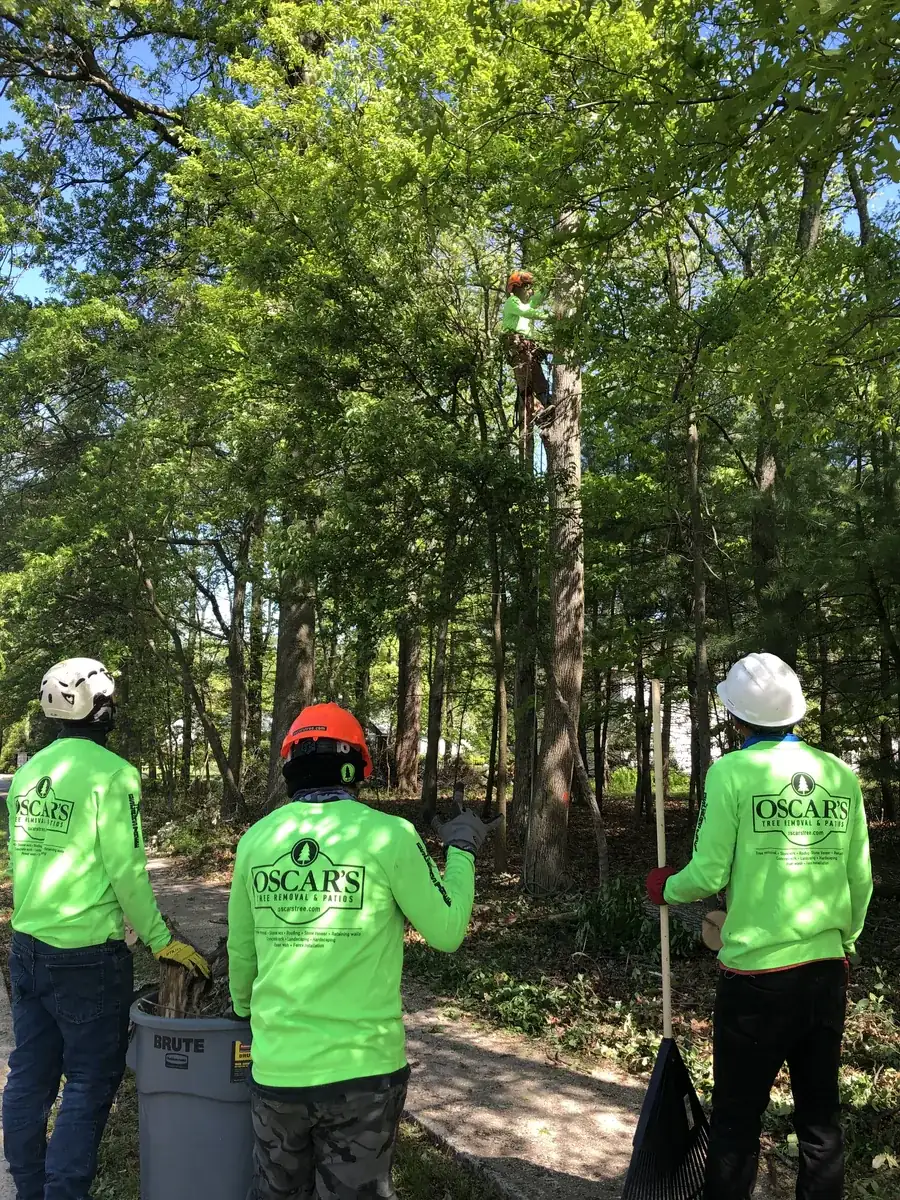
All cuts follow ANSI A300 pruning standards. We work methodically through the canopy, making proper lateral cuts at the right positions. We don't rush, and we don't cut corners because nobody's watching. Every branch is handled - lowered if needed, chipped or stacked for cleanup.
Full Cleanup Before We Leave
All debris is chipped or hauled before we pack up. We rake the area, blow debris off hard surfaces, and do a walk-through. Your property is lawn-ready when we leave - not tomorrow, the same day.
Tree Trimming Throughout Bucks County & the Lehigh Valley
We're based in Dublin, PA - centrally located in Bucks County - and serve communities throughout the county and into the Lehigh Valley. No matter where you are in our service area, the same crew and the same standards show up.
Tree Trimming in Bucks County - Frequently Asked Questions
The questions we hear most from Bucks County and Lehigh Valley homeowners before scheduling a trimming visit.
What is the difference between tree trimming and tree pruning?
Trimming is primarily about controlling size and appearance - clearing rooflines, keeping canopies from overhanging driveways, maintaining a tidy shape. Pruning is a more targeted, health-focused practice: removing dead, diseased, or crossing branches to improve airflow, reduce hazard, and encourage strong growth. In practice, most homeowners need both, and a professional crew handles them together in a single visit.
When is the best time to trim trees in Bucks County, PA?
Late winter through early spring - roughly February through mid-March - is the ideal window for most deciduous trees. Trees are dormant, structure is visible without leaves, and pruning wounds begin closing as soon as spring growth resumes. Pest and fungal activity is at its lowest point in the year. Summer trimming is fine for light clearance and deadwood removal. Avoid scheduling major pruning cuts in fall if you can push it to winter instead.
Why can't oak trees be trimmed between April and July?
Oak wilt is a lethal fungal disease spread by sap-feeding beetles that are most active April through July in southeastern Pennsylvania. Fresh pruning cuts during this window attract the beetles and can directly introduce the fungus into an otherwise healthy tree. Oak wilt kills quickly and spreads to neighboring oaks through root grafts. In Bucks County, we strongly advise trimming oaks only between November and March. If a hazard branch must come down during the high-risk season, we treat the cut surface immediately to minimize attraction.
How much does tree trimming cost in Bucks County, PA?
Most homeowners in Bucks County pay $150-$350 for small ornamental trees, $300-$600 for mid-sized trees in the 20-40 foot range, $500-$900 for large trees in the 40-60 foot range, and $800-$1,500+ for very large trees over 60 feet. Access-restricted sites - tight yards, hillside properties, trees over rooflines - add cost due to equipment or rigging requirements. All estimates are free, on-site, and in writing before work begins. Call (267) 245-5320 to schedule.
How often should trees be trimmed?
Most mature shade trees benefit from professional trimming every 3-5 years. Young trees may need structural pruning every 2-3 years to build strong branch architecture early. Fast-growing species like silver maple, Bradford pear, or cottonwood may need attention more frequently. Fruit trees are typically pruned annually. If you have hazard branches, storm damage, or branches encroaching on structures, those should be addressed regardless of where you are in a regular schedule.
What is crown reduction and when is it needed?
Crown reduction decreases the overall height or spread of a tree's canopy by cutting branches back to appropriate lateral growth points - not to stubs. It's used when a tree has grown too close to a structure, is becoming top-heavy and storm-vulnerable, or is blocking significant light. Done correctly, it maintains the tree's natural shape and allows wounds to close properly. It's not the same as topping, which creates stubs the tree cannot seal and leads to decay and structural weakness.
What's wrong with topping a tree?
Topping - cutting branches back to stubs - creates large wounds trees cannot close, inviting decay at every cut. It triggers rapid regrowth of weak "water sprouts" that are more hazardous than the original canopy and need re-cutting within 2-3 years. Topped trees become structurally weaker over time and significantly more expensive to maintain. We never top trees. Crown reduction achieves the same size management goal using proper lateral cuts that the tree can actually heal from.
Do you trim trees near PECO or PPL power lines?
Yes. We trim trees growing toward or in contact with power lines on the homeowner's side throughout Bucks County (PECO territory) and Northampton County (PPL territory). For branches in direct contact with energized distribution lines, the utilities' line clearance crews handle that specific zone. We coordinate everything on the property side - completing the full job safely around the utility infrastructure. Not sure who handles what? Read our full guide on tree removal near power lines.
Two related guides worth a read: the best time to trim trees in Pennsylvania and how much tree trimming costs in Bucks County.
Is the Emerald Ash Borer affecting trees in Bucks County?
Yes. EAB is widespread throughout Bucks County and Lehigh Valley. Every untreated ash tree in the region should be considered at risk. We assess ash trees during any trimming visit and advise honestly on their condition - whether treatment is still viable or removal is the right call. Trees in early-stage infestation can often be protected with systemic insecticide treatment. Late-stage trees should come down before they become structural hazards, since dead ash fails fast and unpredictably.
Do I need a permit to trim trees in Bucks County?
In most cases, trimming trees on private residential property in Bucks County does not require a permit. However, some municipalities have tree ordinances covering street trees, trees in the public right-of-way, or trees above a certain diameter on specific property types. Properties near conservation easements, the Delaware Canal corridor, or watershed protection zones may have additional requirements. We can flag anything relevant when we visit for the estimate.
What pruning standards do you follow?
We follow ANSI A300 pruning standards - the benchmark established by the American National Standards Institute for professional tree care. ANSI A300 specifies proper cut placement at branch collars and lateral growth points, maximum canopy removal limits per pruning cycle, and wound closure best practices. Following these standards is what separates professional tree work from amateur cutting that shortens a tree's life and creates long-term problems.
Ofrecen servicio de poda de arboles en espanol?
Si - nuestro equipo bilingue ofrece servicio completo de poda y recorte de arboles en espanol en todo el condado de Bucks y el Valle de Lehigh. Yes - our bilingual crew provides full tree trimming and pruning service in Spanish throughout Bucks County and the Lehigh Valley. Call or text (267) 245-5320.
Ready for a Free Tree Trimming Estimate in Bucks County?
We'll come to your property, walk every tree you want looked at, and give you a written price before anything is agreed to. 240+ five-star reviews. ANSI A300 pruning standards. Full cleanup included. Call us or fill out the form below.
Get a Free Tree Trimming Estimate in Bucks County, PA
Fill out the form and we'll be in touch to schedule an on-site visit. We walk your property, assess every tree, and provide a written estimate - no pressure, no obligation.
- On-site visits - we come to you
- Written estimate before any work begins
- No obligation, no pressure
- Residential and commercial properties
- Serving all of Bucks County & Lehigh Valley