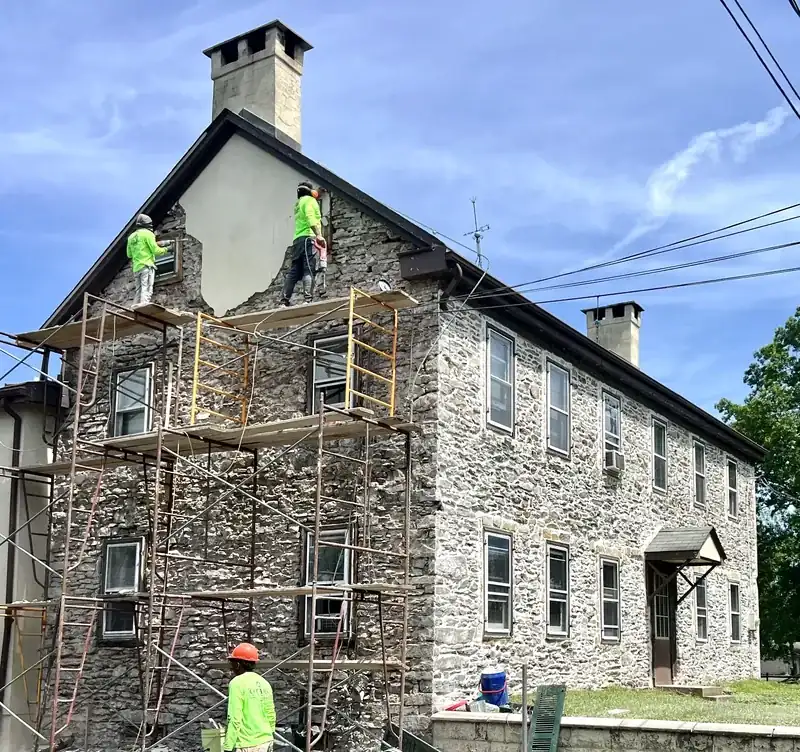
Stone Veneer Repair & Repointing
in Bucks County, PA
Cracked mortar, loose stones, and water damage don't fix themselves - and every season you wait adds hundreds to the repair bill. We assess, repair, and repoint stone veneer throughout Bucks County and the Lehigh Valley. Free same-day estimates.
The Short Answer
Cracked mortar, loose stones, and water seeping behind veneer are all fixable - but only if caught before the substrate is damaged. We assess, repair, and repoint stone veneer throughout Bucks County and the Lehigh Valley. If the underlying wall is still sound, a targeted repair is far less expensive than a full section replacement. Free same-day estimates - call (267) 245-5320 or fill out the form below.
Signs Your Stone Veneer Needs Repair
Most stone veneer problems start small and stay that way - until Pennsylvania's freeze-thaw cycle gets involved. Here's what to look for before one season becomes a major repair.
Cracked or Missing Mortar Joints
Hairline cracks eventually become open joints. Open mortar joints are the #1 entry point for water behind stone veneer. If you can insert a credit card into a joint, it's past due for repointing. Don't wait for visible water damage to appear - by then, the mortar failure is already doing structural harm.
Loose or Shifting Stones
A stone that moves when you press it is no longer bonded to the substrate. This can mean mortar bond failure, water damage behind the stone, or both. Loose stones left in place will eventually fall - and whatever knocked them loose is still damaging the stones around them.
White Chalky Staining (Efflorescence)
That white powdery deposit on your stone is efflorescence - mineral salts left behind as water moves through your veneer system and evaporates on the surface. It's cosmetic, but it's a sign that water is actively moving through open mortar joints or cracks. Find and fix the entry point, then treat the deposits.
Water Staining or Dark Streaks
Dark vertical streaks running down from mortar joints or stone seams indicate water is channeling through failed joints or cracks. Dark staining on interior walls directly behind exterior stone veneer is a more serious sign - water has made it through the substrate and into the wall assembly. At that stage, the repair scope expands significantly.
Spalling or Flaking Stone Faces
Spalling - where stone faces chip, flake, or pop off in layers - is usually caused by water freezing and expanding inside the stone itself. It's most common on natural stone that has absorbed significant moisture over multiple freeze-thaw seasons. Spalling stones need to be replaced; sealing alone won't stop the damage once it starts.
Gaps at Windows, Doors, and Corners
The intersection of stone veneer with window or door frames, and at outside corners, is the most vulnerable part of any installation. Caulk and mortar shrink and crack here first. Gaps at these transitions allow water to run directly behind the stone face - especially during wind-driven rain. These spots need repointing or caulk replacement at the first sign of opening.
Stone Veneer Repair Services
Every repair job starts with an honest assessment of what's actually wrong - not a sales pitch for the most expensive solution. Here's what we do and when each repair type is appropriate.
Repointing & Tuckpointing
We remove deteriorated mortar to the correct depth - typically 3/4 to 1 inch - using a grinder or chisel. We never surface-coat over bad mortar. Fresh mortar is packed to match the original joint profile, color, and texture. This is the most common stone veneer repair and the most important one to catch early: properly done repointing lasts 20 to 30 years. Surface coating without removal fails within 2 to 5 years and masks the problem until it's worse. We back all repointing with our 10-year written warranty.
Stone Repair & Replacement
Individual stones that are cracked, broken, spalling, or have fallen can often be replaced without disturbing the surrounding installation. We assess the substrate behind the removed stone before setting a replacement, which is the step most contractors skip. Stone matching is the most challenging part of this repair: we source replacements from regional quarries and manufactured stone suppliers, and we're honest with you about how close a match is achievable for your specific installation. You see the replacement stone before it goes in.
Water Damage Assessment & Remediation
When water has made it behind the stone, the repair scope goes beyond mortar. We remove the affected section of veneer, assess the underlying substrate and water-resistant barrier, and repair or replace what's damaged before reinstalling stone. On wood-framed substrates, this can involve replacing compromised sheathing or framing members. We identify the source of water entry first - without fixing the cause, any repair to the surface is temporary. Waterproofing sealant is applied where appropriate as part of the remediation scope.
How the Repointing Process Works
Repointing is a straightforward process - but only when each step is done correctly. Skipping mortar removal or using the wrong mix creates a repair that looks good for one season and fails in the second.
Free On-Site Assessment
We look at the full picture: the mortar joints, the stone faces, the areas around windows and corners, and we probe for hollow stones and soft substrate. We're looking at the cause of the failure, not just the visible symptoms. The estimate you get reflects what the job actually needs - not a minimum number that grows once we're on-site.
Mortar Removal
Deteriorated mortar is removed to a minimum depth of 3/4 to 1 inch using an angle grinder with a mortar rake blade or a cold chisel for tighter joints. This is the step that separates proper repointing from a surface patch. Surface patches fill in over failed mortar without addressing the adhesion problem and fail within a few seasons. Every joint we repoint is cleaned to sound material before anything goes back in.
Mortar Matching & Packing
We formulate mortar to match the original in color, aggregate texture, and joint profile. The mix is packed in layers into each joint, pressing firmly to eliminate voids, and tooled to match the original joint shape - whether that's a concave rake, a flush joint, or a V-profile. For historic or natural stone installations, we use lime-based mortars where appropriate to maintain the flexibility the original installation intended.
Cleanup & Optional Sealant
Once the mortar has cured, we clean mortar haze from stone faces and remove all debris. Where appropriate for the stone type and location - particularly on porous natural stone or on north-facing walls that stay damp - we apply a penetrating waterproof sealant. Sealing is not appropriate for every stone type and we'll tell you honestly whether it makes sense for your installation. Full cleanup is always included.
What Does Stone Veneer Repair Cost in Bucks County?
Pricing for stone veneer repair depends on the stone type, mortar color matching complexity, access to the work area, and the total scope. The ranges below reflect typical projects in the Bucks County and Lehigh Valley markets. A free estimate gives you the exact number for your job before any work is scheduled.
| Repair Type | Typical Cost Range |
|---|---|
| Minor repointing - 1 to 2 linear feet (isolated crack, corner gap, window surround) | $200 - $500 |
| Moderate repointing - small section (4-12 sq ft) | $500 - $1,500 |
| Full wall repointing (larger surface area, full foundation strip or retaining wall face) | $1,500 - $4,000+ |
| Single stone replacement (matching, removal, substrate inspection, reset) | $150 - $400 per stone |
| Water damage repair including substrate remediation | $800 - $3,000+ depending on extent |
Why Early Repair Saves Thousands
Stone veneer failure doesn't happen all at once. It starts with cracked mortar, progresses to open joints, advances to water infiltration, and eventually reaches the substrate. Each stage is substantially more expensive to fix than the one before it.
A repointing job on a problem section - before water has gotten behind the stone - typically costs $500 to $1,500. That same section, if the water infiltration has reached the substrate and caused sheathing damage, can easily run $3,000 to $6,000+ once you factor in substrate removal, moisture remediation, new water-resistant barrier installation, and reinstalling stone over a repaired wall. That's if you can match the stone.
Pennsylvania's freeze-thaw cycle is particularly unforgiving. Bucks County averages more than 20 freeze-thaw events per year. Each event forces water that has infiltrated open mortar joints to expand as it freezes, widening cracks and pushing stones away from the substrate. Two or three seasons of this can turn a surface repair into a full section rebuild.
The math is simple: get the free estimate now, repoint what's failing, and you're protected for the next 20+ years. Wait, and you're looking at a project that multiplies in scope with every winter.
The Cost of Waiting - Bucks County Reality
"Ignoring cracked mortar for 2-3 seasons can turn a $600 repointing job into a $6,000 full section rebuild."
We see it every year. A homeowner notices cracked mortar, figures it's cosmetic, and holds off. By the time they call us, the water has gotten into the substrate. The stone has to come down. The sheathing needs replacing. The water barrier has to be reinstalled. Then the stone goes back up - if we can still match it. The original mortar problem would have been a half-day job. The deferred version is a full week.
Every Repair Backed by Our 10-Year Written Warranty
Our warranty covers workmanship defects including mortar failure, stone movement, and water intrusion related to our installation. Not a verbal promise - a signed document you keep. No other stone veneer contractor in Bucks County offers a warranty this comprehensive on repair work.
Get a Free Repair Estimate →Stone Veneer Repair & Repointing Throughout Bucks County & Beyond
Stone Veneer Repair & Repointing FAQs
Questions we hear often from Bucks County homeowners dealing with stone veneer problems. Straight answers, no sales pitch.
Repointing - sometimes called tuckpointing - is the process of removing deteriorated mortar from stone veneer joints and replacing it with fresh mortar that matches the original color and profile. You need it when the mortar between your stones is cracking, crumbling, pulling away from the stone faces, or missing entirely. Left unaddressed, open mortar joints allow water to get behind the stone, which accelerates damage significantly in Pennsylvania's freeze-thaw climate. As a general rule: if you can see a gap or stick a credit card into a mortar joint, it's time to repoint.
The most visible signs of water infiltration behind stone veneer include dark water staining or streaks on the stone faces, efflorescence (white chalky mineral deposits), stones that feel hollow when tapped, sections of veneer that are bulging or pulling away from the wall, and interior moisture or staining on the wall directly behind the veneer. If you see any of these, don't wait - water behind the stone causes substrate damage that turns a repair job into a full replacement project. Oscar's provides free on-site assessments to evaluate both the visible stone and the substrate condition behind it.
In most cases, yes. Mortar color matching is one of the most important parts of a repointing job - mismatched mortar stands out immediately and looks worse than the original problem. We assess the existing mortar color, texture, and joint profile during our estimate visit and formulate a mix that closely matches the original. For older installations where the original mortar has weathered significantly, we blend to match the current weathered color rather than the original unweathered tone. We'll show you a sample before we commit mortar to a full section.
Properly done repointing - where the deteriorated mortar is fully removed to the correct depth and replaced with the right mortar mix for exterior Pennsylvania use - should last 20 to 30 years before needing attention again. Surface coating over bad mortar without proper removal fails within 2 to 5 years. This is why we never surface-coat over deteriorated mortar and always grind or chisel to clean depth. Oscar's backs all repointing work with a 10-year written warranty.
It depends on the condition of the substrate and the extent of the failure. Repair - including repointing, individual stone replacement, and targeted water damage remediation - is the right answer when the water-resistant barrier behind the stone is still intact and the substrate is sound. Full replacement is necessary when water has compromised the underlying substrate, when the original installation lacked a proper moisture barrier, or when stone movement is widespread across a section rather than isolated. Oscar's assesses both the stone and the substrate before recommending anything. We'll tell you honestly whether repair is a real long-term fix or just delaying a larger project.
Stone veneer itself is not structural - it's a cladding attached to the building substrate. However, when water infiltrates through cracked mortar and reaches the structural wall behind the veneer (typically wood framing, OSB sheathing, or concrete block), it can cause wood rot, mold, and deterioration of the underlying structure. In extreme cases - particularly on older installations without a proper moisture barrier - long-term water infiltration behind veneer can cause significant structural damage to the wall assembly. This is another reason early repair matters: fixing mortar joints is far less expensive than remediating a rotted wall cavity.
Efflorescence is the white chalky deposit that appears on stone or mortar surfaces when water moves through the masonry and carries dissolved salts to the surface, where they crystallize as the water evaporates. It is a sign that water is moving through your stone veneer system. Efflorescence itself doesn't damage the stone - it's primarily cosmetic. But it signals that water is moving through mortar joints or cracks, which is the actual problem that needs to be addressed. Treating efflorescence without finding and fixing the water pathway is temporary at best. We identify the source of moisture movement, seal or repoint the entry points, and then treat the efflorescence deposits.
A small repointing job - a single problem section, a few linear feet of failed mortar around a window or corner - typically takes one to two days including proper mortar cure time between coats. A full wall repointing project on a larger surface takes three to five days depending on the size and complexity of the area. We can give you a specific timeline during the estimate visit once we've assessed the full scope of the work.
In most Bucks County municipalities, repointing and individual stone replacement are considered maintenance work and do not require a building permit. More extensive repairs that involve replacing the substrate, modifying the underlying wall assembly, or structural changes may require a permit depending on the municipality. We recommend confirming with your township or borough's building department if your project involves anything beyond surface repair. We'll let you know during our estimate if what we're seeing is likely to trigger a permit requirement in your area.
Technically, tuckpointing and repointing are different techniques, but in common use - especially in the Mid-Atlantic region - the terms are often used interchangeably. True tuckpointing involves filling joints with mortar that matches the stone color, then adding a thin raised ribbon of contrasting mortar in the center of the joint to create the visual illusion of very fine, precise mortar lines. It's more of a decorative technique associated with brick work. Repointing is the general term for removing deteriorated mortar and replacing it with fresh mortar. When homeowners in Bucks County say tuckpointing, they almost always mean repointing - and that's what we do.
Cracks in your mortar don't wait.
Neither should you.
Every season you hold off on a repointing job, Pennsylvania's freeze-thaw cycle widens those cracks a little further. A $600 repair today is a $6,000 rebuild next year. Call us or fill out the form below - free estimates, same-day scheduling available.
Get Your Free Stone Veneer Repair Estimate
Tell us about your stone veneer problem and we'll schedule a free on-site assessment. We'll look at the mortar, the stone, and the substrate, and give you a complete written estimate before any work is scheduled.
No pressure, no upsell. If repair is the right answer, we'll tell you that. If the substrate is too far gone and you need a full replacement, we'll tell you that too.