Warning Signs of a Hazardous or Dangerous Tree
The clearest warning signs of a hazardous tree are dead or hanging limbs, a sudden or worsening lean, cracks and cavities in the trunk, soil heaving or lifting roots at the base, and mushrooms or fungus growing on the trunk or roots. If a tree is touching or near a power line, stay far away and call 911 and your utility immediately. When in doubt, have an experienced tree specialist inspect it in person.
A tree can look fine from your kitchen window and still be one storm away from coming down on your house, car, or driveway. In Bucks County and the Lehigh Valley, our mix of heavy summer thunderstorms, high winds, wet clay soil, and freeze-thaw winters puts real stress on trees every year. The good news: most dangerous trees give off warning signs long before they fail. This guide walks you through what to look for so you can tell whether your tree is a risk that needs attention.
Oscar's Tree Removal & Stone Veneer has handled 1,000+ jobs across the area since 2016, and our experienced tree specialists have seen firsthand which warning signs tend to come right before a tree fails. If anything below sounds like your tree, it is worth a closer look.
Dead, Hanging, or Broken Limbs
Dead and broken limbs are the most common tree hazard, and also the easiest to spot. Look up into the canopy for branches with no leaves during the growing season, bare limbs that stay bare while the rest of the tree fills in, or limbs that have snapped and are hung up in the branches below. These are often called "widowmakers" for a reason: a single hung-up limb can drop without warning in the next gust of wind.
- Large dead branches, especially those over a house, driveway, deck, or play area
- Cracked or partially attached limbs left behind after a storm
- Branches rubbing power lines or hanging over the sidewalk
- Piles of small dead twigs and branches dropping onto the lawn
Sometimes the fix is professional trimming rather than full removal, but dead wood high in a large tree is dangerous to reach and should be handled by a crew with the right equipment, not a homeowner on a ladder.
A Leaning Trunk
Not every leaning tree is dangerous. Some trees have grown at an angle for years, reaching for sunlight, and are perfectly stable. What worries us is a new or worsening lean, especially one that appears after a storm. A sudden lean usually means the root system is failing or the soil is giving way underneath it.
Warning signs that a lean is serious:
- The tree started leaning recently or the angle is getting steeper
- Soil is cracked, mounded, or lifting on the side opposite the lean
- Roots are visibly pulling out of the ground
- The lean points toward your home, a structure, or a power line
A tree leaning more than about 15 degrees from vertical, or one leaning toward something it could damage, should be inspected quickly.
Cracks, Splits, and Cavities in the Trunk
The trunk carries the whole weight of the tree, so damage here is serious. Walk the full circle of the trunk and look for deep vertical cracks, splits where the trunk divides into two main stems, and hollow cavities or soft, crumbling wood. A tree with two large stems joined in a tight V-shape (called a weak or included union) is prone to splitting apart in a storm, often taking half the tree down at once.
Peeling bark with dead wood underneath, seams that run up and down the trunk, and open wounds where a limb tore away are all signs the tree's structure is compromised. Small, sealed-over wounds are usually fine. Large or deep ones are not.
Root and Soil Problems at the Base
What happens at ground level often decides whether a tree stands or falls. The roots are the anchor, and in our region's wet clay soil, root problems are common, especially after heavy rain saturates the ground and a windstorm follows.
- Heaving soil: raised, cracked, or mounded ground on one side of the tree means the roots are lifting
- Exposed or lifting roots: roots pulling up out of the soil signal the anchor is failing
- Cut or damaged roots: recent trenching, driveway work, or construction near the tree can destabilize it
- Soft, dark, or decaying roots: a sign of root rot, which is hard to see and often fatal to the tree
Root failure is one of the most dangerous problems because the tree can look completely healthy up top right up until it topples.
Mushrooms and Fungus at the Base or on the Trunk
Mushrooms, shelf-like conks, or fungal growth on the trunk, base, or exposed roots are a red flag. Fungus feeds on dead and decaying wood, so its presence usually means the tree is rotting from the inside, where you cannot see it. A tree can hold up a surprisingly full canopy while its core quietly turns to punk. If you see mushrooms growing out of the trunk or clustered at the base, treat it as a sign to get the tree inspected, even if it otherwise looks healthy.
A Dead or Dying Tree
A fully dead tree is a hazard on a timeline. As the wood dries out and decays, it gets brittle and unpredictable, and it becomes both more likely to fail and more dangerous to remove. Around here, the clearest example is the emerald ash borer, an invasive beetle that has killed a huge number of ash trees across Bucks County and the Lehigh Valley. Dead ash trees become brittle fast and are notoriously dangerous to take down, which is exactly the kind of job for a crew with a spider lift rather than climbers.
Not sure whether your tree is dead or just stressed? Our guide on how to tell if a tree is dead walks through the scratch test and other quick checks. Either way, a confirmed dead tree near anything you care about should be scheduled for removal before the next big storm.
Storm Damage
Our storms do not politely finish their work. A tree can survive a storm looking mostly intact while hiding a cracked limb, a split crotch, or loosened roots that make it far more likely to fail in the next round of wind. After any major storm, walk your property and look for fresh cracks, hanging or snapped branches, a new lean, and lifted soil at the base.
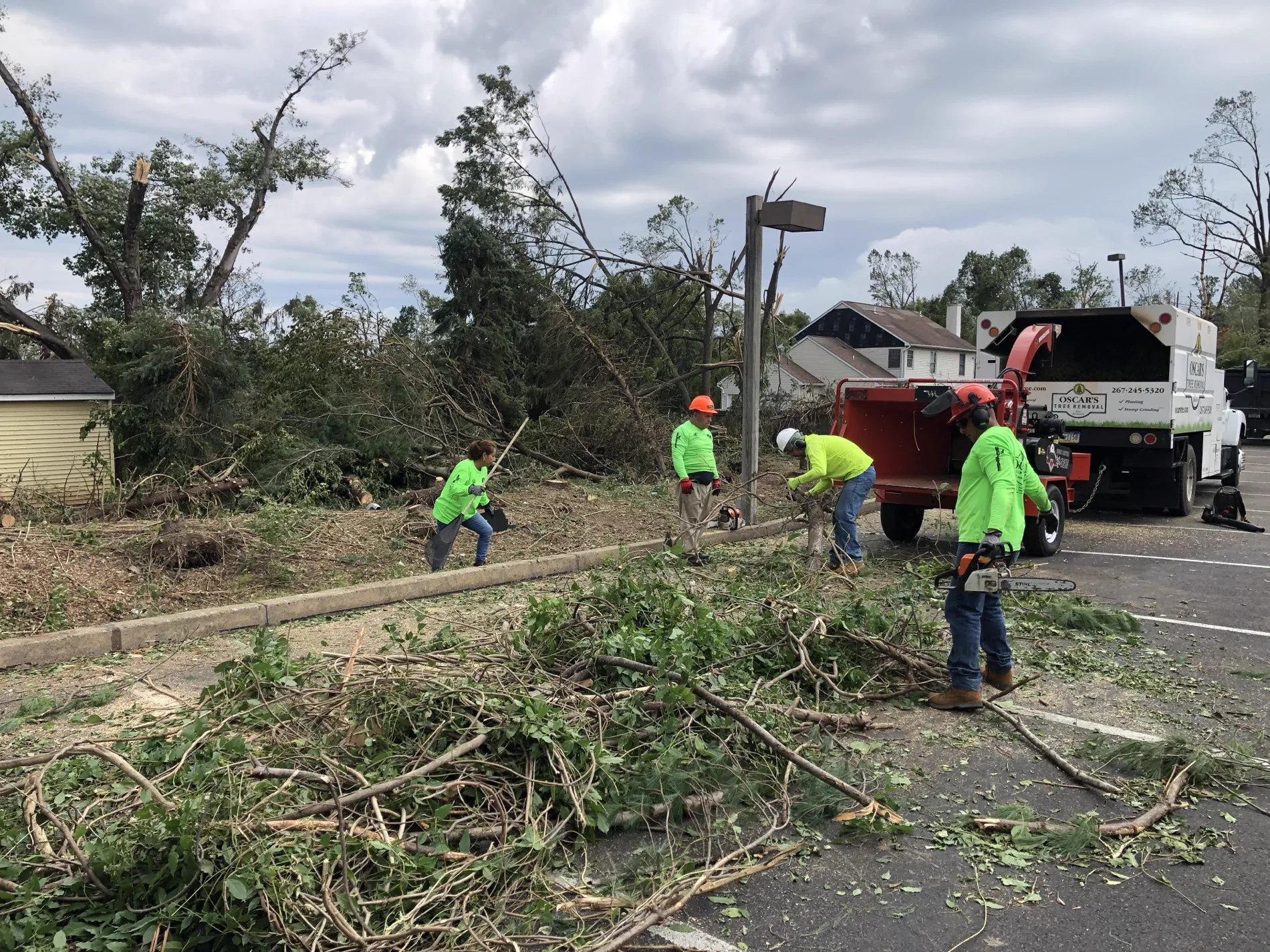
If a storm has already brought a tree or large limb down, or left one hanging over your house, that is an emergency. Oscar's offers 24/7 emergency and storm-damage tree service across Bucks County and the Lehigh Valley, with same-day response when it counts.
Proximity to Your House and Power Lines
Two identical trees can carry very different levels of risk depending on what is underneath them. A tree with minor issues in the back corner of a large lot is a different situation than the same tree leaning over your bedroom or the road. When you are weighing risk, factor in the target: your house, garage, driveway, the neighbor's property, the street, and anywhere people gather.
Power lines change everything. If any part of a tree is touching, resting on, or growing into a power line, do not touch the tree, do not try to trim it, and keep everyone well clear. Downed or tree-tangled lines can energize the ground and the tree itself. Call 911 and your utility company immediately, and stay far away. Never assume a line is dead. For more on how this work is handled safely, see our overview of tree removal near power lines in Bucks County.
Quick Risk Reference
| Warning Sign | How Urgent |
|---|---|
| Tree or limb touching a power line | Emergency - call 911 and utility, stay away |
| Tree or large limb already down on a structure | Emergency - call for 24/7 response |
| New or worsening lean, heaving soil | Urgent - inspect within days |
| Large dead limbs over a target area | Soon - schedule removal or trimming |
| Trunk cracks, cavities, or fungus | Soon - have it inspected |
| Old, stable lean away from structures | Monitor - mention at next estimate |
When to Call a Professional
If you have spotted one or more of these warning signs, the safest next step is an in-person inspection by someone who does this every day. Many hazards, like internal rot and root failure, are hard to judge from the ground, and climbing a compromised tree yourself is how people get seriously hurt. Oscar's Tree Removal & Stone Veneer is family-owned, licensed and insured, and known for showing up on time and doing the job right, with 240+ five-star Google reviews to back it up. We are "Everything Outside. One Crew." with no subcontractors, and our spider lift handles the tight-access removals that are hard to climb.
We offer free in-person estimates (usually same or next day) with no obligation, and we are available 24/7 for emergencies. Call or text (267) 245-5320, or reach out through our contact page, and we will take a look at your tree and give you a straight answer.
Frequently Asked Questions
Worried About a Tree? Get a Free Inspection
Free, same-day, in-person estimates with no obligation. Call or text and Oscar takes a look himself.