Dead Ash Tree Removal in Bucks County, PA
A dead ash is not like other dead trees. Once emerald ash borer kills it, the wood turns brittle fast, and limbs and tops can snap with no warning. That's why we take dead ash down from our own spider lift instead of sending a climber up it. Free on-site estimates across Bucks County and the Lehigh Valley.
Why Is a Dead Ash Tree More Dangerous Than Other Dead Trees?
Emerald ash borer larvae feed just under the bark and cut off the tree's ability to move water. Penn State Extension notes that a heavy infestation can kill an ash in three to four years, and that removal is the main option once a tree is too far gone. After that, the clock speeds up: Purdue researchers found that dying ash become extremely brittle and break easily, so a tree that's safe to take down this year can be dangerous to take down next year.
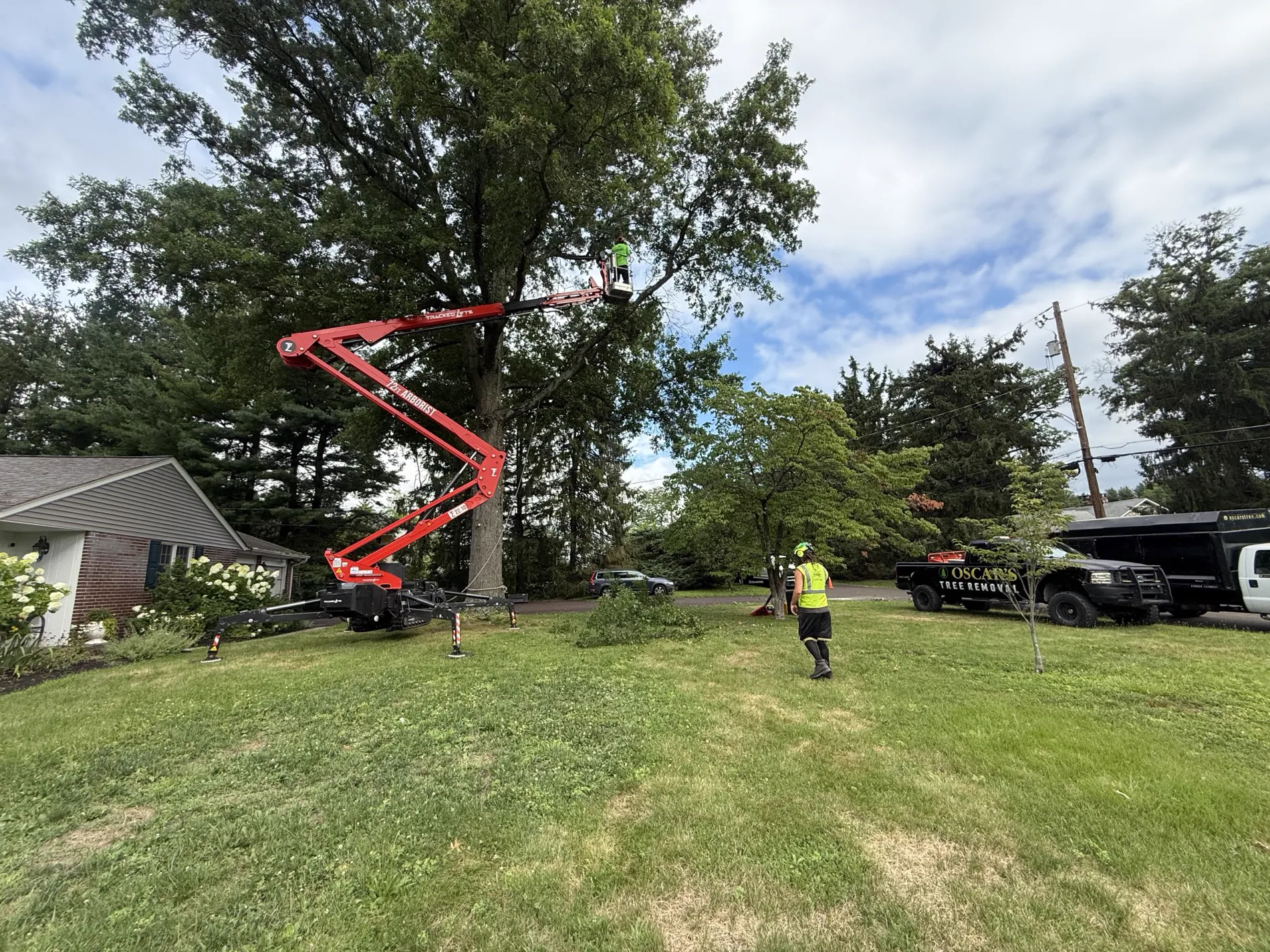
That brittleness is what makes dead ash a different job. A live oak can be climbed and rigged. A dead ash may not hold a climber, and the tree care industry's own trade magazine has warned that critically dead ash tends to fail during rigging, often in the first several feet. The safer approach is to work the tree from a lift parked beside it, so nobody's weight is ever on the dead wood.
Bucks County has a lot of these trees. Ash was planted along streets, in front yards and along wooded property lines for decades, and many of them are now standing dead. If you have one near your house, driveway, a play area or a neighbor's property, it's worth getting it looked at before a storm decides the timing for you.
Our Own Spider Lift
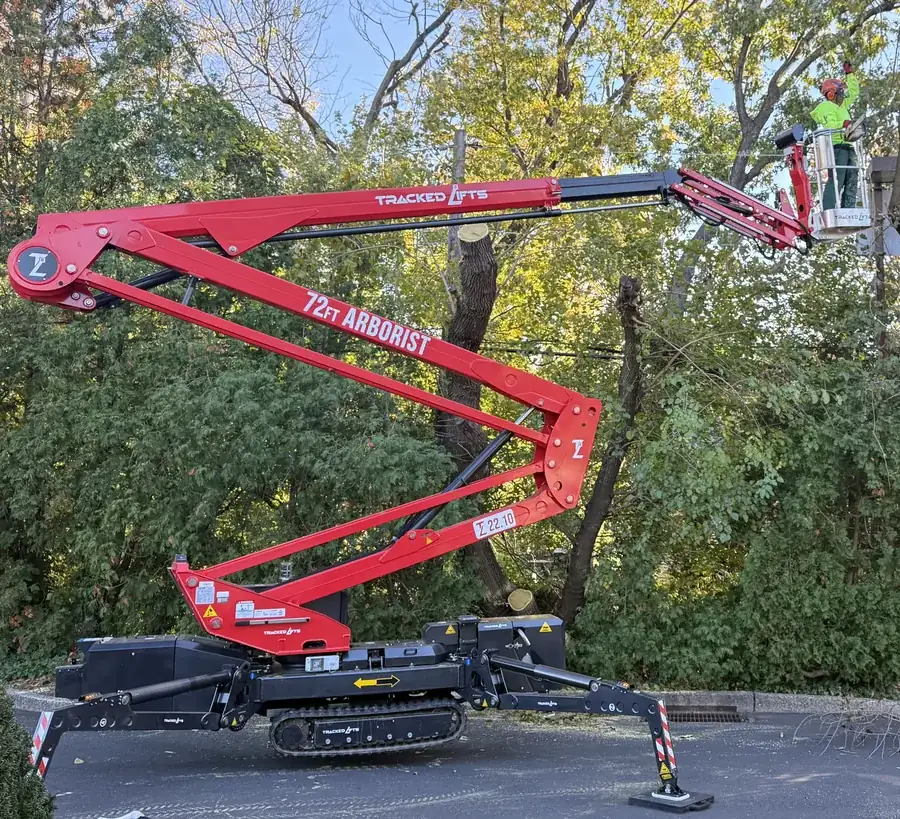
A compact tracked lift that fits through backyard gates and side yards, so the crew works the tree from a basket, not from the tree itself.
Earlier Is Safer
Purdue's guidance: once an ash has lost about 30% of its canopy, plan the removal. Waiting only makes the wood more brittle.
Dead Doesn't Mean No Permit
Some towns still require a permit for dead trees, including Doylestown Borough and Upper Makefield. Check with your municipality before the job.
Keep the Wood Local
Moving ash firewood is one of the main ways the beetle spreads. Wood left on your property as rounds, or chipped on site, stays local.
How Do You Remove a Dead Ash Without Climbing It?
Every dead ash is a little different, but the job follows the same order.
Look at It From the Ground
At the free estimate we check how far gone the tree is, what it would hit if it failed, how the lift gets back there, and whether a service wire to your house is in the way.
Set Up the Lift Beside It
The spider lift tracks through the gate or side yard and sets its outriggers next to the tree. No truck on the lawn, and no one leaning a ladder or climbing into dead wood.
Take It Down in Sections
Working from the basket, the crew removes the top and limbs piece by piece, so each section comes down under control instead of the whole tree falling toward something.
Chip, Cut and Clean Up
Branches go through the chipper on site. Logs can be cut into rounds and left for you or hauled away. The stump can be ground the same visit.
Dead Ash Jobs, in Our Customers' Words
5.0 stars from 240+ Google reviews.
Two Giant Dead Ash
“Oscar recently took down two giant dead ash trees on my property... same day estimate, service the next week. The trees were taken down and wood left in neat piles.” — Nicole O'Keefe, Google review
Four Ash, Then Back Again
“Five years ago, Oscar removed four ash trees from our house. We were very happy with their professional work and fair pricing - so we asked Oscar to do the job again.” — Megumi Masters, Google review
Oscar on Every Job
“Oscar is a rarity in today's world. Answers phone himself. Leads the crew.” — Philip Charles, Google review, October 2026
Insured & Registered
Liability insurance and workers' comp, and registered with the PA Attorney General as a home improvement contractor (PA HIC #PA125632). Ask for a certificate of insurance before any job.
How Can I Tell If My Ash Tree Is Dying From Emerald Ash Borer?
Ash trees usually die from the top down. The first thing most homeowners notice is a thin or bare crown while the lower branches still leaf out, often with a burst of sucker growth on the trunk as the tree struggles. Heavy woodpecker activity is another giveaway, because woodpeckers go after the larvae under the bark. If your neighbors' ash trees are dying too, yours is probably infested as well.
A dead tree you know about is also a liability question. Under Pennsylvania law, an owner in a developed or residential area can be held responsible if a tree they knew, or should have known, was defective falls and causes damage (MacElree Harvey). Homeowners insurance also tends to pay little for removal itself: Consumer Reports notes that removal coverage is often capped around $500 to $1,000, and if a fallen tree doesn't hit a covered structure, the owner usually pays. For more on who pays when a tree comes down, see our guide to fallen tree responsibility in Pennsylvania.
- Thinning or bare branches in the top third of the crown
- "D"-shaped exit holes in the bark, about 1/8 inch across
- Vertical bark splits showing S-shaped tunnels underneath
- Heavy woodpecker damage and missing patches of bark
- Sucker shoots sprouting from the trunk or base
- Several ash on the street or property declining at once
Dead Ash Tree Removal Questions
The questions homeowners ask us most about dead and dying ash.
Related Services & Guides
More on spider lift work, dead trees and tree removal across Bucks County.
Get It Looked At Before the Next Storm
Call or fill out the form below. We'll walk the property, look at the tree and the access, and give you a written price before any work starts.
Get Your Free Dead Ash Removal Estimate
Tell us about your project and we'll get back to you the same day. No pressure, no obligation - just honest, upfront pricing.