Fireplace Refacing with Stone in Bucks County, PA
Keep the firebox, keep the chimney, lose the dated brick. We cover old brick, painted brick, tile and plain drywall surrounds with natural thin stone or manufactured stone, without tearing the fireplace out.
A New Face on the Fireplace You Already Have
Refacing means putting a new surface on the front of an existing fireplace. The firebox, the chimney and usually the hearth stay where they are. What changes is everything you look at: the orange 1970s brick, the brick someone painted white in 2005, the builder tile around a gas unit, or the flat drywall box that never looked finished.
Stone is the usual choice because it bonds to masonry and handles the heat around a fireplace. What decides whether it lasts is the part nobody sees: what the existing surface is, whether it is painted, how solid it is, and how the stone meets the firebox, hearth and mantel. That is what this page covers. For stone on a fireplace being built or framed from scratch, see our stone veneer fireplace surrounds page covers that work.
Call (267) 245-5320 or use the estimate form below. We come out, look at the fireplace, and give you a written scope and price.
Can You Put Stone Over a Brick Fireplace?
Yes, in most cases. Cultured Stone's installation instructions allow adhered stone to go directly onto clean, untreated, unpainted masonry with no lath at all. Plenty of unpainted brick fireplaces fit that. We check a few conditions at the estimate:
- Is the brick solid? Loose bricks, cracked joints or crumbling faces get repaired first. Stone bonded to a weak surface is only as strong as that surface.
- Is it painted, sealed or coated? Mortar does not bond reliably to paint or sealer. More on that below.
- Is it clean? Soot and grime get cleaned off first.
- Is it flat enough? Heavily textured or out-of-plane brick may need a mortar coat first so the stone sits in a consistent plane.
- What sticks out? Brick ledges, raised hearths, arched openings and old mantel shelves each need a decision: cut back, wrap in stone, or build around.
Painted Brick, Tile and Drywall: Prep by Surface
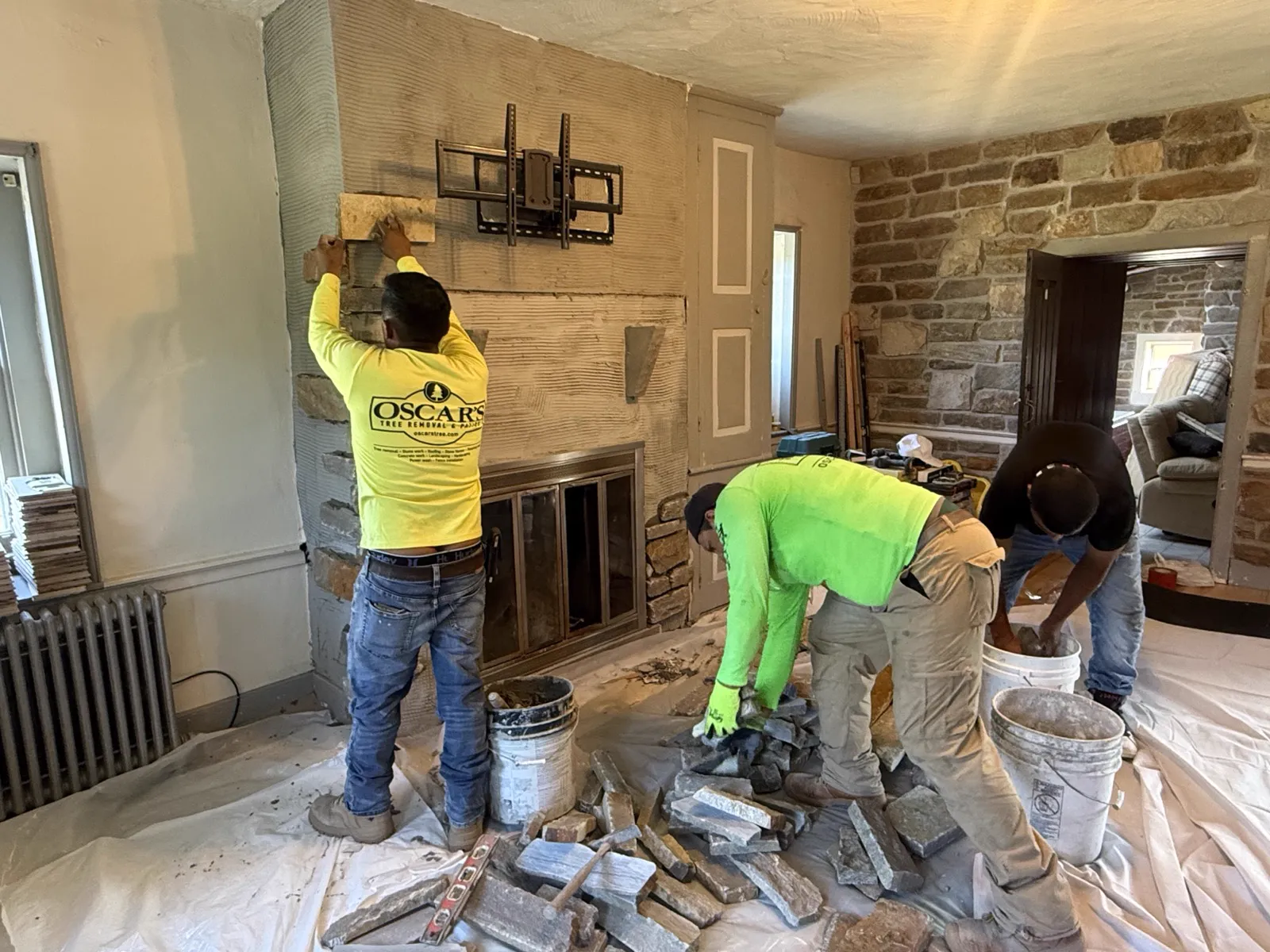
Every refacing job starts with one question: what will the mortar bond to? The answer sets the prep, the schedule and a good share of the cost. Here is how common surfaces are handled under manufacturer instructions.
| Existing surface | What we check | Typical prep before stone |
|---|---|---|
| Bare brick | Loose or spalling brick, cracked joints, soot and grime | Repair, clean, dampen the surface, then set stone directly in mortar. Some brick gets a mortar coat first to even out the plane. |
| Painted or sealed brick | Type of coating and how well it is stuck | Cultured Stone's instructions: blast back to the original masonry, or securely attach metal lath and apply a scratch coat. Indoors, lath and scratch coat is usually the cleaner route. |
| Ceramic or stone tile | Whether the tile is bonded and what is behind it | Glazed tile is too slick for mortar. Remove it, or cover it with lath fastened through to solid backing, then a scratch coat. |
| Drywall surround | Framing behind it and the fireplace unit's manual | Not a mortar base on its own. Water-resistive barrier, metal lath fastened into the studs, then a 3/8" to 3/4" scratch coat (Cultured Stone's range). |
| Concrete block | Form oil, paint, loose surface | Clean, untreated block can take stone directly. Painted or coated block is treated like painted brick. |
The stone you choose has its own installation instructions, and those govern the job.
Why painted brick is the one that trips people up
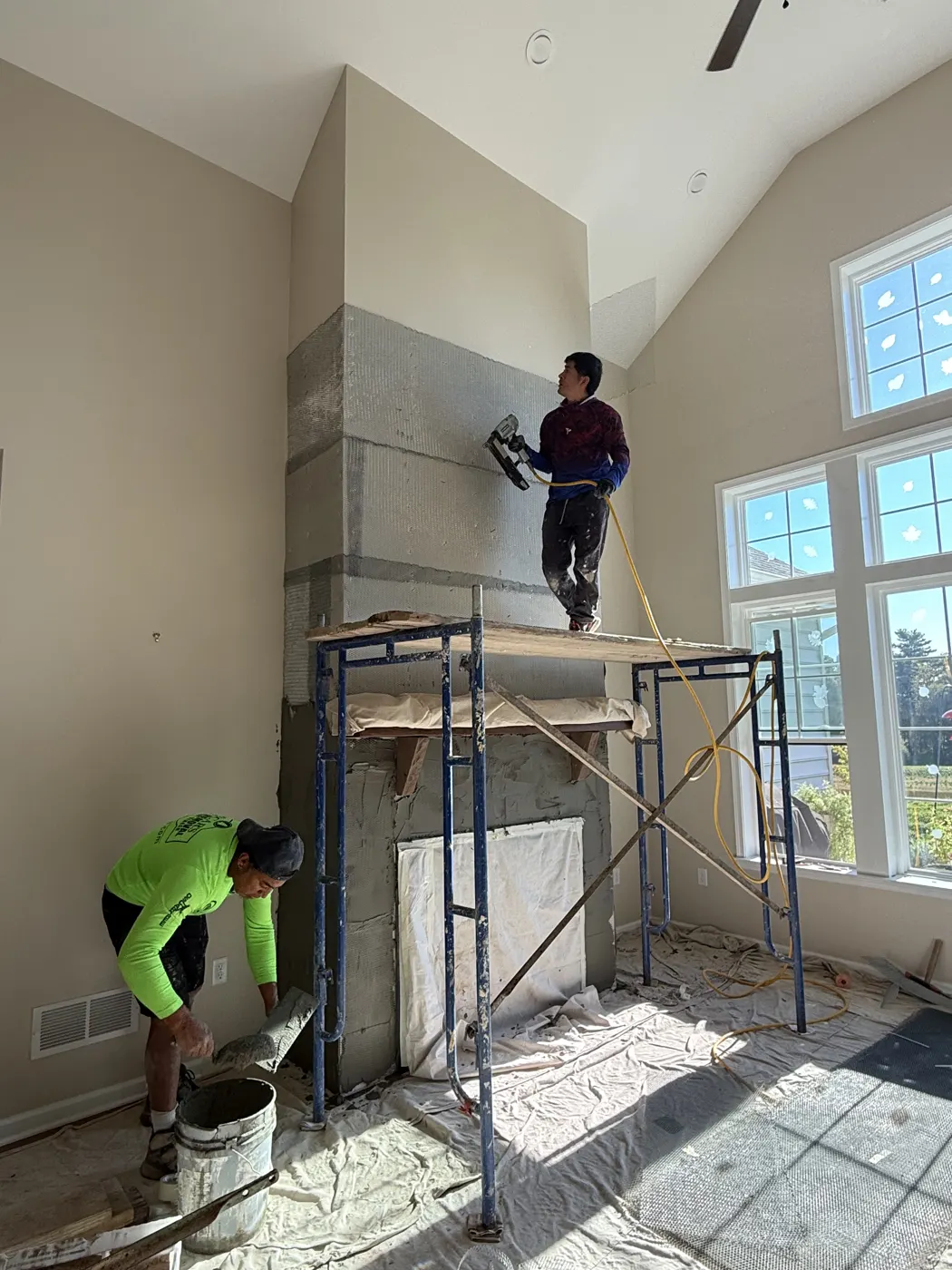
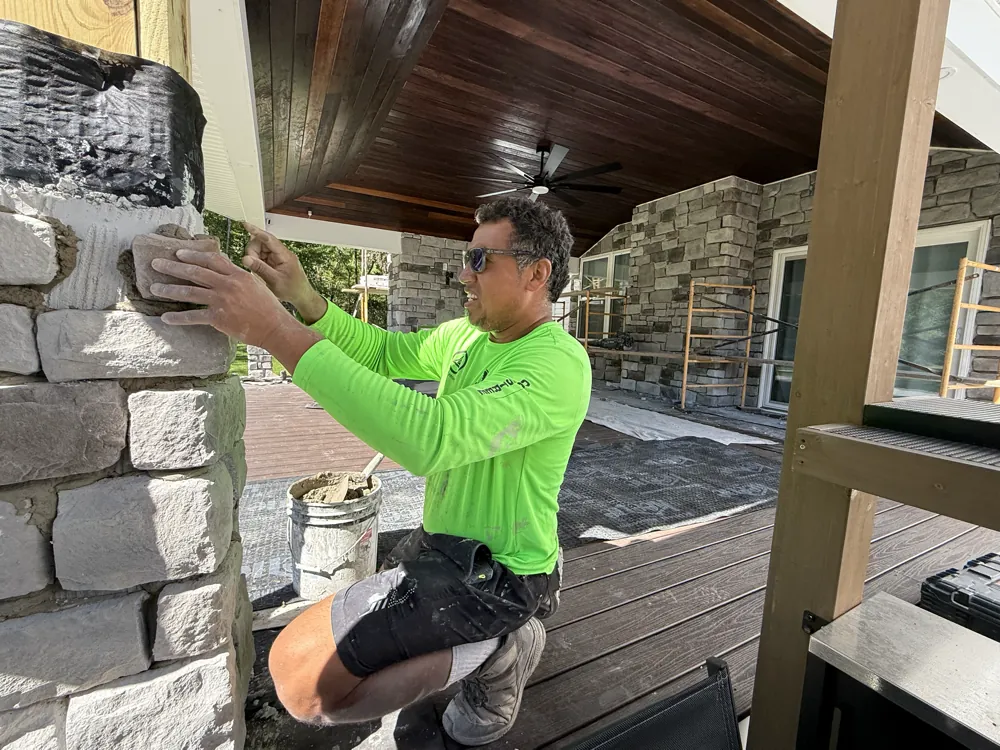
Mortar troweled onto paint bonds to the paint, and the paint is only as strong as its grip on the brick. If that layer lets go, the stone goes with it. This Old House's guide puts it simply: if the surface has paint, add wire lath for a better bond. Lath is expanded steel mesh fastened to the wall. The scratch coat is mortar troweled into it and raked with grooves so the setting mortar can key in. Below, the crew fastens lath on the upper chimney breast while the lower section already has its scratch coat.
Natural Thin Stone or Manufactured Stone for a Refacing Job
Both work over an existing fireplace, and our guide to stone veneer types covers the general differences. On a refacing job, these matter most:
- Depth. New stone adds its own thickness plus the mortar bed, and lath and a scratch coat add more. That depth has to work with glass doors, insert trim, the mantel, outlets, and the door and window casing next to the fireplace.
- The edge at the firebox. Cut edges show where stone meets the opening, and some inserts need their trim kit to stay removable.
- Heat. Manufactured stone makers set their own limits. Eldorado Stone says its veneer must be at least 18 inches from any open flame, which can decide what lines the returns on a wood fireplace.
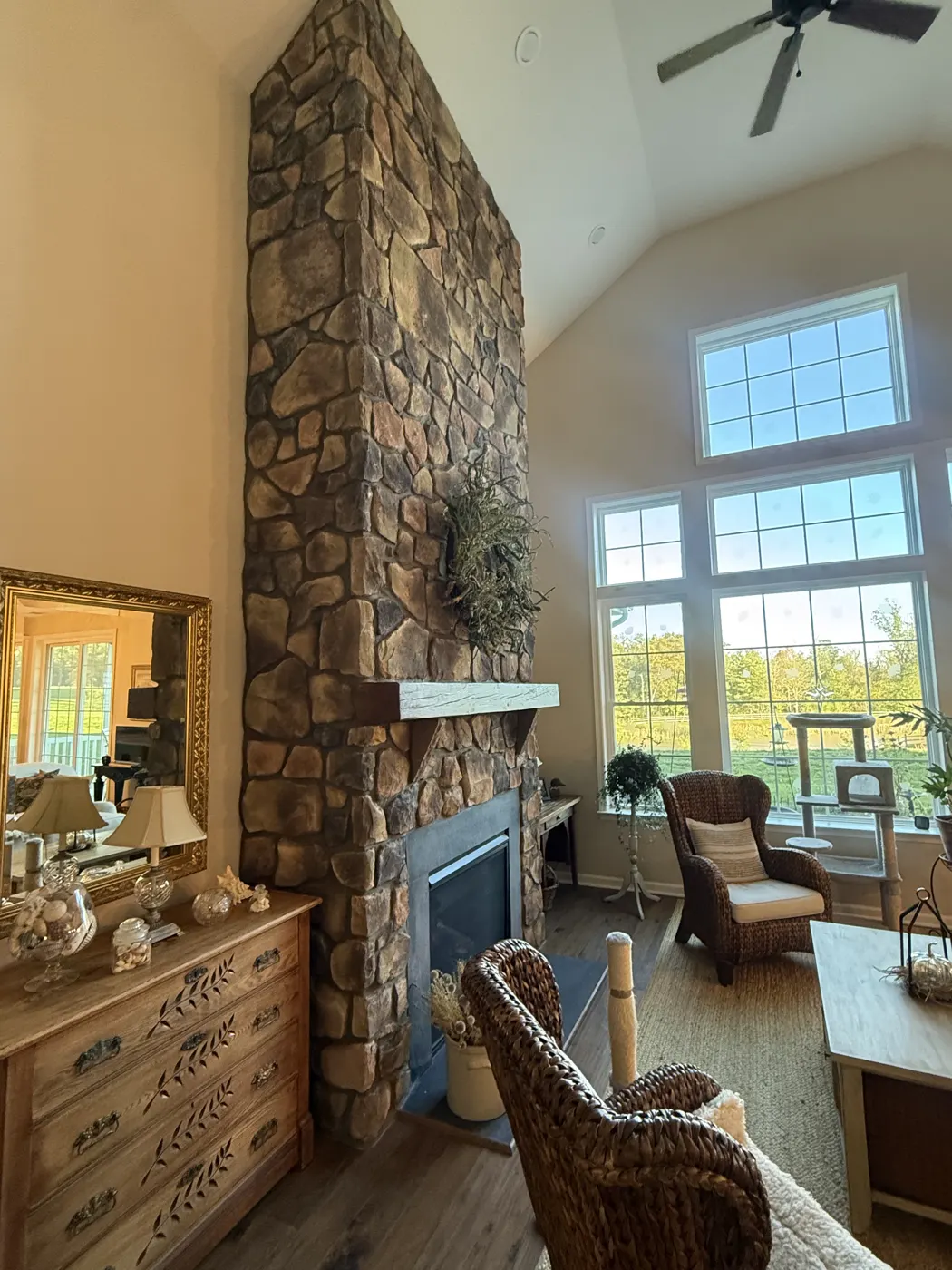
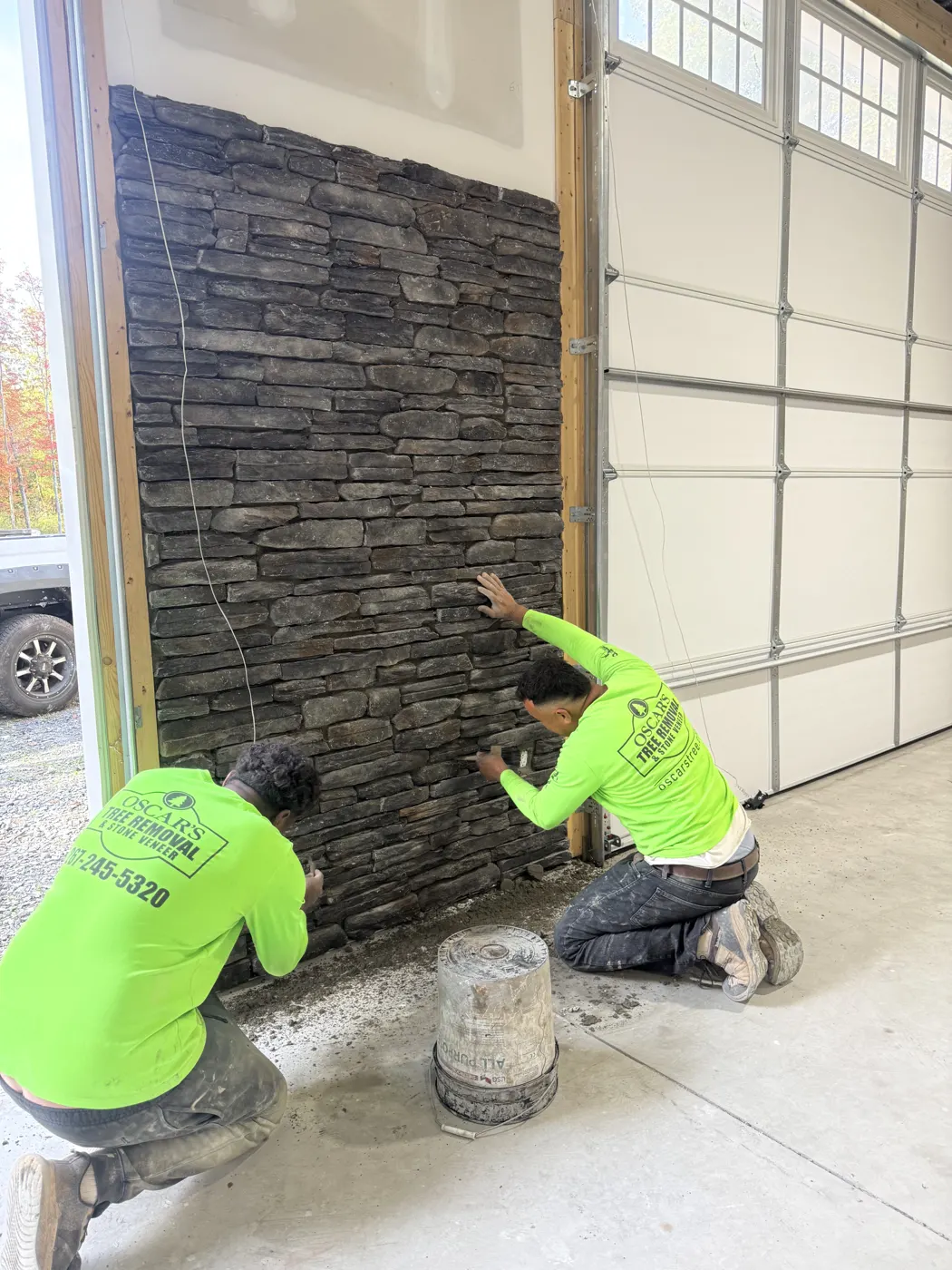
- Matching the house. In older Bucks County stone homes, natural stone is often the closer match to original walls. In newer homes, manufactured stone gives a consistent color across a big wall.
Tight-joint ledgestone reads modern. Fieldstone with wider joints reads farmhouse. Both go over brick the same way.
Clearances, Heat and Your Type of Fireplace
Stone does not burn. The clearance questions are mostly about what goes around it, especially a wood mantel, and which rules apply to your fireplace.
Masonry wood-burning fireplaces
The International Residential Code, Section R1001.11, sets the rules for combustible trim and mantels on the front of a masonry fireplace. Nothing combustible can sit within 6 inches of the opening. Between 6 and 12 inches, combustible trim can project only 1/8 inch for every inch of distance from the opening. Bob Vila's refacing guide puts a wood mantel at least 12 inches above the opening, more for deeper mantels.
The hearth extension in front of a masonry fireplace has its own minimums under Section R1001.10: at least 16 inches in front and 8 inches past each side, or 20 and 12 inches when the opening is 6 square feet or larger.
Gas inserts and factory-built fireplaces
Most gas fireplaces and many wood units in newer homes are factory-built. For those, the unit's installation manual controls mantel clearance, allowed facing materials and how close they can come to the opening, and it can be stricter than the general code. We work from that manual. If you do not have it, the model number on the rating plate usually finds it.
Get the chimney checked before the stone goes up. A new face does nothing for a cracked flue liner or damaged firebox. NFPA 211, as quoted by the Chimney Safety Institute of America, says chimneys, fireplaces and vents shall be inspected at least once a year. We are stone installers, not chimney sweeps, so have a CSIA-certified chimney sweep inspect it first.
Permit rules vary by township. If the plan includes a new insert, gas work or firebox changes, check with your township's code office.
Hearth, Mantel and How High the Stone Goes
Raised hearth or flush hearth
Many older brick fireplaces have a raised brick hearth across the wall. You can face it with stone and cap it with a slab such as bluestone, cut it down, or replace it with a flush hearth. Keeping it is the least work. Removing it frees floor space but adds demolition and floor patching.
Mantel
The old brick ledge or painted board is usually replaced with a wood beam or stone shelf. Its anchoring is planned before the stone goes on, since it fastens through to the masonry or framing. HomeAdvisor lists custom mantels at $500 to $3,000.
Hearth-to-mantel or all the way up
Stone can stop at the mantel, run to the ceiling, or follow a cathedral ceiling to the peak. Going higher adds square footage, scaffolding, and lath and a scratch coat on the framed chase above the brick.
The TV, outlets and lighting
A TV mount, wiring, outlets and sconces get planned before the stone covers the wall. Moving them later means cutting stone.
Stone vs. Tile vs. Paint: Ways to Reface a Fireplace
The common routes, with national figures from HomeGuide's 2026 fireplace remodel cost guide:
| Option | HomeGuide figure | What to know |
|---|---|---|
| Paint the brick | $350 – $650 total | Cheapest and fastest. The brick shape and pattern stay, and painted brick is harder to cover with stone later. |
| Tile | $10 – $50 per sq ft installed | Clean, flat and modern. Needs a very flat base, so brick usually gets skimmed or covered first. |
| Stone veneer | $45 – $75 per sq ft installed | Natural texture and depth. Goes over most masonry with the right prep. Works hearth-to-mantel or floor-to-ceiling. |
| Natural stone | $50 – $150 per sq ft installed | The widest range. Depends heavily on the stone and how it is cut. |
Source: HomeGuide, "How Much Does a Fireplace Remodel Cost? (2026)." National averages, not quotes.
Stone hides an uneven surface better than tile, which is one reason it is the usual choice over old brick. More comparisons: stone veneer vs. brick vs. stucco.
What a Refacing Job Looks Like, Day by Day
Most refacing jobs follow the same order:
- Estimate visit. We look at the surface, firebox type, hearth and wall above, talk through stone, and give you a written scope and price.
- Protect and prep. Floors are covered and the firebox is closed off. Old tile, brick ledges or a hearth come out if planned. Loose brick is repaired and the surface cleaned.
- Lath and scratch coat (when needed). Painted brick, tile and framed walls get metal lath and a raked scratch coat. The scratch coat has to firm up before stone goes on, so this often adds a day.
- Setting stone. Stone is laid out to balance color and size, then back-buttered and set from the bottom up, corners and firebox edges first.
- Joints, hearth and mantel. Joints are filled and tooled. Excess mortar is brushed off once firm, since wiping it wet smears the stone. The hearth cap and mantel go in.
- Cleanup and walkthrough. We clean up and go over the finished fireplace with you.
A hearth-to-mantel refacing over sound brick is often a few working days. Floor-to-ceiling walls and jobs that need lath and a scratch coat take longer.
What Does Fireplace Refacing Cost?
We do not publish our own prices because no two fireplaces need the same prep. These are national figures from two cost guides, so you have a starting point before the estimate.
Per Square Foot, Over an Existing Fireplace
HomeAdvisor’s figure for installing stone veneer over an existing fireplace. Some designs and patterns run higher.
Average Fireplace Refacing Project
HomeGuide’s average total for refacing, across all materials.
Stone Veneer, 5 to 25 Square Feet
HomeGuide’s total for a stone veneer reface of a small surround, including removal of old material.
A 5 to 25 square foot surround is small. A floor-to-ceiling wall in a great room can be several times that, so totals scale with the wall.
The biggest swing factors on a refacing job: square footage, natural vs. manufactured stone, whether the surface needs lath and a scratch coat, hearth changes, the mantel, and scaffolding for tall walls.
More detail on how stone pricing works locally: stone veneer cost in Bucks County.
Caring for a Refaced Stone Fireplace
Stone veneer needs little upkeep:
- Clean gently. A soft bristle brush and a mild soap or detergent solution, then a clean water rinse. Eldorado Stone and Cultured Stone both warn against wire brushes, acid cleaners and power washing.
- Sealer is optional. See the FAQ below.
- Watch the joints. A cracked joint or a loose stone is easier to fix early. Our stone veneer repair and repointing service handles that.
The Fireplaces We See in Bucks and Montgomery County
Plenty of Bucks and Montgomery County homes built from the 1960s through the 1990s share the same fireplace: a full brick wall or a brick chimney breast, a raised brick hearth, and a wood or brick mantel ledge. Some have been painted. Some have had a gas insert added. Most of the time the masonry is sound and the fireplace just looks its age.
In older stone farmhouses, the goal is often stone that fits the original house. In newer developments, it is usually a drywall surround around a gas unit getting stone to the ceiling. For stone on other walls, see stone accent walls and interior stone veneer, or start at the stone veneer overview.
Tired of the old brick? We'll look at it and tell you exactly what it needs.
Request Your Free EstimateFireplace Refacing Across Bucks & Montgomery County
Fireplace Refacing: Frequently Asked Questions
Can you put stone veneer over an existing brick fireplace?
Yes, in most cases. Manufacturer instructions allow adhered stone directly on clean, untreated, unpainted masonry. The brick has to be solid, so loose or crumbling brick is repaired first. Painted, sealed or very dirty brick is either blasted back to bare masonry or covered with metal lath and a scratch coat.
What if my brick fireplace is painted?
Mortar does not bond reliably to paint. Cultured Stone's instructions give two options for painted or sealed masonry: blast it back to the original surface, or securely attach metal lath and apply a scratch coat. Inside a finished room, lath and a scratch coat is usually the cleaner choice.
Can stone go over ceramic tile or drywall around a fireplace?
Not directly. Glazed tile is too slick for mortar, so it is removed or covered with lath fastened to solid backing. Drywall needs a water-resistive barrier, metal lath fastened into the studs and a scratch coat. On a factory-built fireplace, the unit's manual also decides what can go around it.
How close can stone and a wood mantel be to the fireplace opening?
It depends on the stone and the fireplace. Eldorado Stone says its veneer must be at least 18 inches from any open flame. For masonry fireplaces, IRC Section R1001.11 keeps combustible trim and mantels at least 6 inches from the opening, and within 12 inches they can project only 1/8 inch per inch of distance. Gas and factory-built units follow their own manuals.
Does refacing work with a gas insert or a factory-built fireplace?
Usually, yes. The unit's installation manual sets clearances, mantel height and allowed facing materials, and we plan the layout from it along with the stone maker's instructions. Some insert trim kits need to stay removable for service, so the stone edge is planned around them.
Do I need to remove my raised brick hearth?
No. It can be faced with stone and capped with a slab, cut down, or replaced with a flush hearth. For masonry fireplaces, the code calls for a hearth extension at least 16 inches deep and 8 inches past each side of the opening, or 20 and 12 inches for openings 6 square feet or larger.
How long does a fireplace refacing take?
A hearth-to-mantel refacing over sound, unpainted brick is often a few working days. Lath and a scratch coat add time because the scratch coat has to set first, and floor-to-ceiling walls add scaffolding and square footage. Your written scope includes the expected schedule.
What does it cost to reface a fireplace with stone?
HomeAdvisor puts stone veneer over an existing fireplace at $45 to $75 per square foot, and HomeGuide lists an average refacing project at $600 to $4,500. Those are national figures. Wall size, stone choice, surface prep, hearth and mantel work decide a real price, which we give in writing after an on-site visit.
Should I get my chimney inspected before refacing?
Yes. A new stone face does nothing for a cracked flue or damaged firebox, and it is better to find those first. NFPA 211 calls for chimneys and fireplaces to be inspected at least once a year. We are stone installers, not chimney sweeps, so we recommend a CSIA-certified chimney sweep.
Does a stone fireplace need to be sealed?
No. Eldorado Stone says sealing is not required, and Cultured Stone notes a sealer can make soot easier to clean off a fireplace face or hearth. If you seal, use a breathable, silane-based sealer, which may darken the stone slightly. Clean with a soft brush and mild detergent, never acid, a wire brush or a power washer.
Sources
- Cultured Stone (Boral), Installation Instructions (surface preparation, scratch coat, cleaning and sealers)
- This Old House, How to Install Stacked Stone Veneer on a Fireplace
- Eldorado Stone, FAQs (fireplace clearance, cleaning, sealing)
- International Residential Code, Sections R1001.10 (hearth extension dimensions) and R1001.11 (fireplace clearance, combustible trim and mantels)
- Chimney Safety Institute of America, Homeowner Resources (NFPA 211 annual inspection)
- Bob Vila, So, You Want to... Reface Your Fireplace
- HomeAdvisor, Stone Fireplace Cost (updated June 2026)
- HomeGuide, How Much Does a Fireplace Remodel Cost? (2026)
Ready to Cover That Old Brick?
We'll come to your home, look at the fireplace and the surface underneath, and give you a written scope and price with no obligation. Oscar's has been doing stone work across Bucks County, Montgomery County and the Lehigh Valley since 2016.